

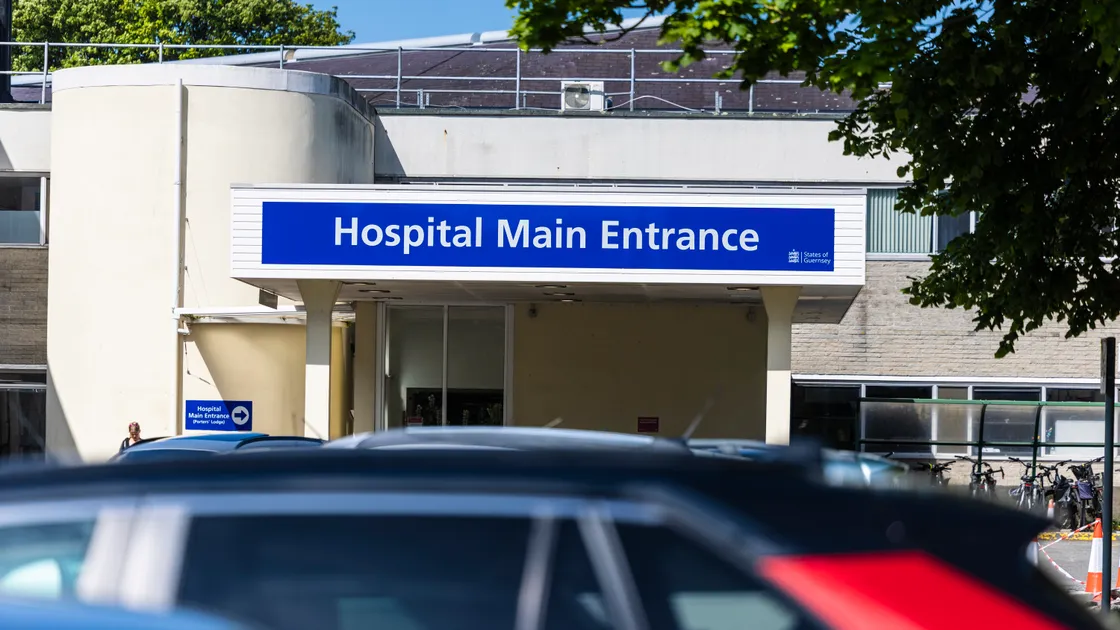
On Friday I was out on my trike, met the man behind the CupNSaucer X account and generally behaved like somebody whose immediate future did not involve an emergency encounter with the inside of the Princess Elizabeth Hospital. By Saturday afternoon my stomach had begun making strange noises. There was some pain, then rather more pain, and increasingly peculiar things happening lower down. I blamed trapped wind, constipation, coming off Mounjaro, Laxido and almost anything else that did not involve seeking medical attention.
ChatGPT was rather less relaxed about it. As Saturday became Sunday and my stomach became increasingly swollen, it kept suggesting that I should seek medical advice. I kept finding perfectly good reasons not to. I have lived in this body for 72 years and felt entitled to an opinion about it, whereas ChatGPT has never even had a stomach.
By late Sunday the pain acquired the casting vote. I was by then sufficiently spaced out that even I abandoned any thought of taking the trike. At about eight o’clock I surrendered myself to my wonderful and long-suffering children and arrived at A&E.
I was particularly lucky to have Haley. I am sure I would have coped without her because the A&E staff were excellent, but through those dark hours she was very much my rod and my staff. It made me realise how fortunate I am to have family close enough simply to take over when required. Not everybody has that. Perhaps when we watch our young people leave Guernsey because they cannot afford a home or find the opportunities they want here, we should remember that we are not merely exporting workers. We may also be exporting somebody’s future support network.
I remember few names from A&E because pain rather interfered with introductions. I do remember that my lifelong reluctance to give blood, even involuntarily, held things up for the best part of an hour. Three valiant people tried. One triumphantly secured about half a vial before the supply dried up. Eventually a third not only extracted everything required but got a cannula into me as well. Well done that man, whoever you are.
Morphine followed. I had always assumed morphine was the point at which pain admitted defeat. Mine hadn’t read the same medical textbook. It barely touched it.
Eventually a CT scan revealed that I had acquired something with the magnificent name of a complete sigmoid volvulus. It sounds less like a medical condition than a particularly comprehensive insult: ‘You, sir, are a complete sigmoid volvulus.’ In reality, part of my large bowel had twisted around itself and created an obstruction.
At about two on Monday morning it was decided I was staying. I had been in A&E since about eight, my last proper night’s sleep had been Friday and I was still in considerable pain, so the prospect of an actual bed was enormously attractive. Thus began my relationship with Giffard
Ward, Bay 2, Bed 2A.
Bay 2 is the best bay. I accept that my comparative research into the others has been limited, but I see no reason to trouble myself with evidence that might contradict a perfectly satisfactory conclusion.
Before I could enjoy the bed, however, a very pleasant lady appeared with a booklet. What sort of house did I live in? Were there steps? Stairs? How many flights? Did I live alone? Did I cook for myself? Did I do my own shopping? Thirty years ago I don’t remember anybody being terribly interested in how many stairs I had at home. But then, of course, I was in my prime.
And then, rather ominously, could I tell her what year it was?
I could. I was rather relieved she didn’t ask what day of the week it was because at two in the morning, having barely slept since Friday, I am not entirely sure I could have answered coherently.
It was my first introduction to something I would encounter several times during my stay. Once you reach a certain vintage, the hospital seems extremely interested not merely in whether it can make you better, but whether it will ever be safe to let you out again. My slightly muddled first thought was, good grief, do they ever release old people from this place?
There was, however, the small matter of my complete sigmoid volvulus to attend to first.
From Giffard I went down to the Day Patient Unit for the procedure. There is something wonderfully absurd about the collision between sophisticated modern medicine and what was fundamentally a plumbing emergency. Scanners had identified the problem, highly trained people surrounded me, drugs were administered and expensive equipment deployed. The ultimate solution nevertheless required approaching the blockage from the least dignified direction available and letting the pressure out.
The subsequent medical report records, with almost insulting casualness, ‘Complete sigmoid volvulus easily decompressed. Gas and liquid aspirated.’
Easily.
It had not seemed particularly easy from my end.
My consultant surgeon, Mr Van Den Bossche, also revealed something unexpected.
‘I read a lot of your stuff,’ he said.
‘Ah,’ I replied, ‘So you’re my reader.’
It is always nice to meet one’s readership.
With the offending bowel successfully untwisted I returned to Giffard and had time to discover what really makes the PEH work.
The staff, to a man and woman, went the extra mile. I don’t say that simply because they looked after me. There were three other patients in Bay 2 and I watched the care they received. I could not have bettered it. Caring certainly, professional absolutely, but also remarkably upbeat. We tolerated no negativity on Giffard.
Charles, a healthcare assistant from Zimbabwe, deserves particular mention. With a royal name it was perhaps inevitable that he should become the king of cheer. Some people lift the atmosphere of a room simply by walking into it. When that room contains four people who would all rather be somewhere else, that is not an insignificant contribution to healthcare.
Then there was Patrick from Rwanda, a great man with a great love of his homeland. Rwanda, rather inconveniently, has developed particularly close relations with Jersey over the years, yet Patrick has chosen to be here. Wise man. He also makes a fantastic cup of tea.
Scarlett, one of our trainee nurses being trained locally, mounted a respectable challenge, but I am sorry, Scarlett, Patrick won by a leaf.
Scarlett matters for another reason. So does Alicia. Scarlett is at the beginning of the route. Alicia trained here too and has progressed into a more senior nursing role, seemingly the boss of our little Bay 2 world. There in front of me was something we ought to be doing much more of. Growing our own, and giving them somewhere to grow afterwards.
We will always need people from elsewhere and, judging by the people I encountered, we have been extraordinarily fortunate in those we have attracted. The PEH I experienced was an extraordinary mixture of cultures and accents, yet somehow remained intensely Guernsey.
Several times I was asked whether I was one of the farming Camps. Of course I am. I encountered a girl Tostevin from a farming family out of Plymouth, and even one of the posh Sark de Carterets rather than the common-or-garden variety. Then, as my cannula was finally being removed, I noticed Saskia’s family name. In Guernsey one cannot simply notice a surname. It has to be investigated.
It turned out that we were cousins. She hadn’t known. My Aunt Winnie was her nan.
Guernsey still exists inside the PEH. It has simply acquired a great many more accents.
Alicia already knows about Pond, my dog, although I never got around to explaining her name. So, Alicia, this bit is for you. Pond was actually bought for my grandson Caleb, who was then a great Doctor Who fan and wanted to be able to say ‘Come along now, Pond’, after the Doctor and Amy Pond. Unfortunately for Caleb, Pond subsequently decided that she was my dog. While I have been incarcerated in Giffard she has apparently spent much of the time on my bed at home howling and regarding the rest of my family as wholly inadequate substitutes.
There are characters everywhere. Lesley brings the food from the kitchen and is a breath of fresh air every time she appears. Hospital menus don’t fit particularly easily with the eating regime I have followed for the past year, but I did have porridge for breakfast. It was unquestionably the best porridge I have eaten all year. It was also the only porridge I have eaten all year.
Even the cleaners seemed determined to ruin my search for something to complain about. I watched one meticulously dusting the tops of the curtain rails, doing a remarkably good impression of Ken Dodd with his tickling stick.
Then the Creativity Cart appeared, sponsored by the School of Popular Music and laden with coloured pencils and paper to relieve the boredom of hospital life. My children decided that I needed it and forced coloured pencils upon me. I regarded this with the dignity one would expect of a 72-year-old man being encouraged to colour in. Then, rather annoyingly, the pencils proved useful. I started making the notes for this very column with them.
Perhaps the Creativity Cart needs a suggestion box as well.
Because one subject kept cropping up in conversations with the people actually doing the work. Waste.
I was surprised to be told that the PEH doesn’t recycle. I haven’t investigated why, and if not recycling saves money I could probably be persuaded to support it. But there is something wonderfully odd about a government that spends so much effort persuading the rest of us to recycle apparently not doing so in its own hospital. Several of the staff, who recycle perfectly happily at home, seemed equally bemused.
One Caribbean lady who had previously worked in care homes raised another example, prescription medicines. Once medicines have been dispensed to an individual, they cannot simply be handed to the next person who needs exactly the same thing. If the prescription changes, or the patient dies, perfectly good unopened medicines can end up being destroyed. She wondered whether institutions might instead be able to hold more commonly used medicines as properly controlled stock and dispense them as required. There may be excellent pharmaceutical reasons why it cannot be done quite like that, but it struck me as precisely the sort of question somebody ought to ask.
I suggested ideas like that ought to travel upwards. She seemed rather less convinced than I was that anybody up there would be listening.
Perhaps that suggestion box really is needed.
Even the organisation of the hospital produces curiosities. The ward clerk is a civil servant operating within this clinical world, while I am told that the cost of laundering hospital sheets doesn’t even sit where one might expect within HSC, but elsewhere in the States property machinery. If that is correct, I apparently owe P&R a vote of thanks for my beautifully clean bedding. This may be the first time that sentence has appeared under my name.
Then there was Judith.
By this stage I had been asked more than once about my ability to survive outside the hospital walls, so I asked her whether they ever actually let old people out. We got into one of those conversations that starts as a joke and ends somewhere quite different.
The problem is obvious. If somebody’s medical treatment has finished but it isn’t considered safe for them to return home, and the care system has nowhere appropriate for them, what exactly is the hospital supposed to do? It cannot simply push them through the doors. Something has to give, and ultimately what gives is an acute hospital bed.
Perhaps we have also set the bar higher than we once did for what constitutes safe independent living. I don’t know. Thirty years ago we may simply have sent people home whom today we would quite properly consider vulnerable. But it left me meandering.
We are spending a very large amount of money increasing hospital capacity because we need more beds. Fair enough. But if some of the beds we already have contain people whom the hospital has fixed but cannot release because the blockage is somewhere in social care, what happens when we build more?
And then I realised that I had heard this story somewhere before. When we needed homes for key workers, rather than build enough dedicated accommodation we found it easier to raid the existing local housing market. The immediate problem was solved by transferring the shortage somewhere else.
Are we doing something remarkably similar with hospital beds? Instead of providing enough appropriate care capacity elsewhere, are we effectively raiding acute hospital beds because they happen to be there?
Building another ward doesn’t necessarily remove that blockage. It merely provides somewhere else for it to accumulate.
I had by then acquired considerable personal expertise in systems where things continue going in while nothing can get out. Eventually the whole thing becomes painfully distended and somebody has to call Mr Van Den Bossche.
It also left me wondering whether putting health and social care together politically was necessarily as clever as it sounded. They obviously have to work intimately together, but their purposes are different. One fixes sick people. The other supports people who need help living their lives. Perhaps joining them makes cooperation easier. Perhaps it also makes it harder to see when failure in one is consuming the resources of the other. A few sleepless nights in Giffard Bay 2 certainly don’t qualify me to redesign the system, but they do qualify me to wonder about it.
None of this should obscure what this column is really about.
When I needed the Princess Elizabeth Hospital, it worked. A&E dealt with a man who was, by then, barely capable of dealing with himself. The problem was found. Mr Van Den Bossche and his team fixed it. Afterwards I watched the people of Giffard care not merely for me but for everyone around me with professionalism, kindness and an extraordinary absence of gloom. The kitchen staff, healthcare assistants, nurses, trainees, cleaners and all the people whose precise place on an organisational chart I couldn’t begin to identify made being ill considerably more tolerable than it had any right to be.
I have occasionally suggested that the States might employ rather more people in HR than humanity strictly requires. Whatever they’re all doing, somebody is certainly finding the right people for the PEH. The sad part is that many recruited from overseas do not see Guernsey as their forever home. That is our loss. Perhaps as much effort needs to go into making good people want to stay as goes into finding their replacements.
I shall continue complaining about States spending. Indeed, listening to the people who actually work inside the system has given me several new reasons to do so. But wanting waste removed from healthcare is not an attack on the people delivering it. Quite the reverse. People this good deserve a system around them that is every bit as good as they are.
So thank you, PEH, and particularly Giffard Bay 2, unquestionably the best bay.
I arrived with a complete sigmoid volvulus and will leave with enormous admiration for the people who fixed it, several new political questions and one piece of information about myself that I had managed to survive 72 years without knowing.
My anus is normal. I have it in writing.


You need to be logged in to comment.