

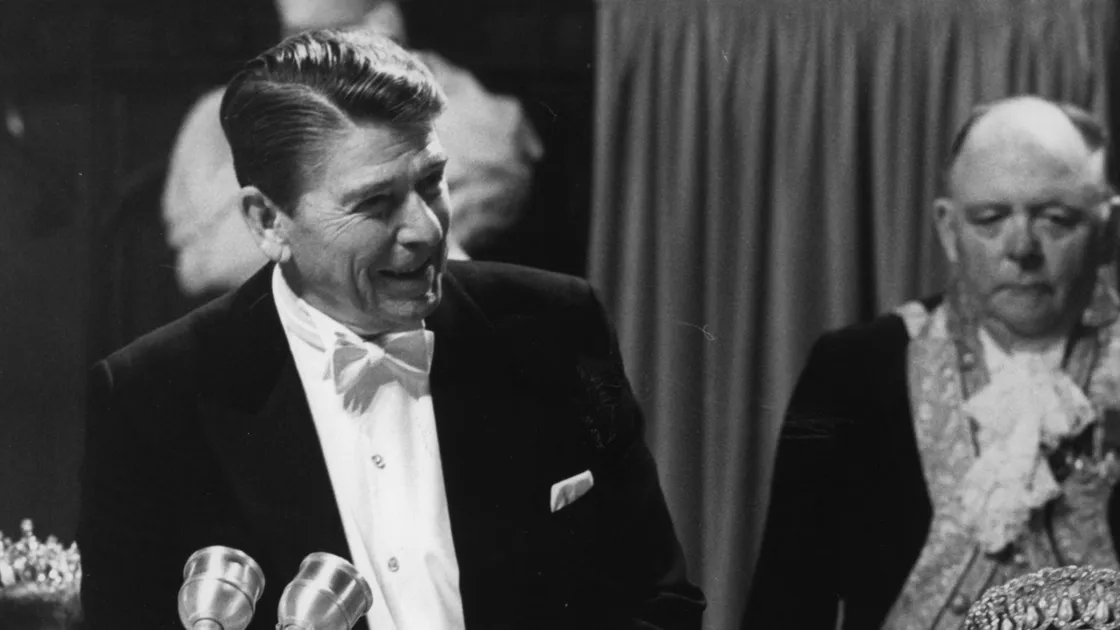
I’m a bit late to it, I know, but I’ve recently developed a rather unhealthy habit of doomscrolling on Facebook. You might be able to imagine my typical feeds. Swing tips, Katie Lam and the Free Speech Union are staples. More recently I’ve been fed a diet of Ronald Reagan addresses. The middle-aged amongst us might recall he had a habit of telling a few tales and jokes at the podium for journalists.
But one clip keeps making me quite sombre. ‘In this present crisis, government is not the solution to our problem; government is the problem.’ Often quoted it’s from his 1981 inaugural address. Go read the whole text; I recommend it. Inspirational stuff. He was talking about the economic crisis facing the US at the end of the ‘70s and the belief that bureaucracy and big government had contributed to the malaise.
The Reagan revolution wasn’t just fiscal; it was ideological too. He went on:
‘From time to time we’ve been tempted to believe that society has become too complex to be managed by self-rule, that government by an elite group is superior to government for, by, and of the people. Well, if no one among us is capable of governing himself, then who among us has the capacity to govern someone else?’
They say the past is a foreign country; they do things differently there. Those words truly are from a different era.
I’ll be frank, reading it makes me nostalgic. Mind, it’s best not to get too wistful about the past. The US was about to enter the Volcker recession as the Fed set out to purge inflation from the system once and for all, and the Tories were embarking on a similar exercise: mass unemployment was ‘a price worth paying’. But it certainly was a time of conviction politics.
The contrast with today is profound. It’s difficult to imagine economic policies that inflicted such demonstrable short-term pain being pursued as they were in the early ‘80s. In the UK, both major political parties have developed an unhealthy tendency to drop leaders at the first sign of unpopularity, while economic priorities have become fixated on benefits and welfare rather than growth. You might have heard me say that before!
It’s something I’ve been wrestling with recently, not least because I’ve started writing another book. The working title is The Economics of Self-Harm. Cheerful stuff, indeed.
Much of the planned book is unfinished business for me. I spent a good deal of the last decade engaged in international policy debates about offshore finance, in which the Channel Islands have been on the losing side of the argument over our economic role and the resulting policy environment. Offshore finance has become a particularly convenient scapegoat. Apparently, if only we could stop wealthy people from putting money in places like Guernsey, many of the fiscal problems confronting Western governments would disappear.
The book challenges the political narratives surrounding wealth, inequality and offshore finance, particularly the influence of economists such as Thomas Piketty and Gabriel Zucman.
If Piketty’s Capital in the Twenty-First Century shifted the dial on wealth and inequality, Zucman’s The Hidden Wealth of Nations did the same for offshore finance and global taxation.
I’ve long challenged Zucman’s analysis and figures. Many of my arguments were made behind closed doors, though I published Convenient Untruths a few years ago. This year, I’ve watched people such as Neil Woodford and UK tax specialist James Quarmby repeat arguments I made privately years earlier. I suppose I’m partly motivated to ensure my original voice is heard.
The first element of economic self-harm is that the UK went along with much of this international agenda and, in the process, surrendered much of its capital hinterland, to its own detriment. But there’s a second, broader thesis. Western governments have developed an extraordinary capacity to pursue policies that undermine their own prosperity. Not intentionally, obviously. But they’ve become rather good at convincing themselves that policies are desirable without troubling themselves too much about their long-term economic consequences.
I’ve been saying it with boring monotony, it seems, but public discourse over the last couple of decades has focused on who has the wealth, who ought to have it, and how governments might redistribute it. Rather less attention has been devoted to the slightly awkward question of where it comes from. Across the West, governments have spent years responding to every problem with more spending, another intervention, or a promise that somebody else will pay. Economic growth has become almost an afterthought.
Anyway, writing a book is quite an undertaking, so naturally I’ve recruited some help from artificial intelligence. I’m something of an enthusiast. I’ve been encouraging colleagues to use AI for some time. Used properly, it can make an enormous difference to the quality and productivity of people’s work.
However, there is a problem.
My AI seems to have developed an obsession with Guernsey. Every time we discuss the book’s structure, it insists I need a chapter on Guernsey, following the United Kingdom down the road of ever-expanding government expenditure and welfare provision. I patiently explain that it’s an internationally focused book. Guernsey isn’t the subject. A few exchanges later, Guernsey is back on the contents page.
I’m beginning to suspect the machine knows something I don’t.
Four years ago, I argued that Guernsey was developing a serious client-state problem and expanded on this point in This is What a Rich Death Feels Like. By that, I meant a political system increasingly preoccupied with distributing other people’s money. More benefits, more services, more promises. Politicians competing to show how much they care by finding new things for government to spend money on. The rather tedious question of who pays tends to come later.
I wasn’t particularly popular for suggesting that at the time. But things certainly haven’t improved.
During the recent GST debate, I found myself quoting the New Testament. ‘Father, forgive them, for they know not what they do.’ I couldn’t remember the chapter and verse at the time. Apparently, it’s Luke 23:34. I was railing against the perversity of the States creating a new welfare payment to offset the impact of its own new tax. Of course, people who need support should receive it. That’s why we have a welfare system. But if the problem is that government cannot afford what it already spends, how does inventing another permanent spending commitment help? As has been my experience over 12 months in the States, my rational economic argument fell on deaf ears. And now, just a few weeks later, Deputy Ozanne is proposing that we introduce the same Essential Costs Relief Payment without GST at all.
For goodness’ sake. This is precisely what I meant by the client state. A payment originally designed to mitigate a new tax somehow is now presented as a desirable spending programme in its own right, even when the tax doesn’t exist. It’s welfare politics imported straight from the UK. Perhaps that’s why my AI keeps insisting that Guernsey belongs in that chapter on the economics of self-harm. I hate to admit it, but I think it may have a point.
Reagan wasn’t arguing that government had no purpose. But he understood something we’ve become remarkably good at forgetting. Government cannot indefinitely spend, regulate and redistribute its way to prosperity. Someone has to create the wealth in the first place. Elsewhere in his address, he added: ‘Great as our tax burden is, it has not kept pace with public spending. For decades, we have piled deficit upon deficit, mortgaging our future and our children’s future for the temporary convenience of the present. To continue this long trend is to guarantee tremendous social, cultural, political, and economic upheavals.’
Now those words don’t sound like they come from a foreign country, do they?






You need to be logged in to comment.