

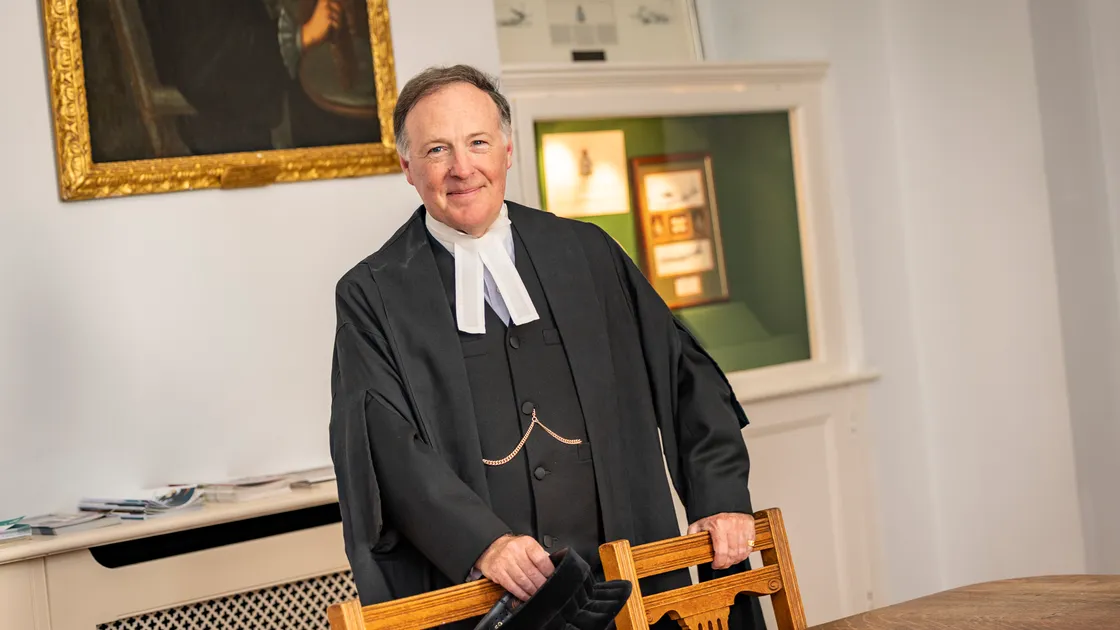
Interviewing Simon Ross reminds me of a line from Baz Luhrmann’s brilliant ‘Sunscreen Song’: ‘The most interesting people I know didn’t know at 22 what they wanted to do with their lives.’
Clerking States meetings is certainly a long way, literally and figuratively, from teaching near a war zone in Asia, studying art history in a posh part of London, and training to be a clergyman in Oxford.
‘Some of the most interesting 40-year-olds I know still don’t,’ the song goes on, which was the age around which Simon was called to the Bar by the Middle Temple.
But by the time the role of States Greffier was created, having previously eschewed a career in the arts, teaching, the clergy and arguably the law, too, in favour of establishing himself as a civil servant, in particular in the courts and the States Assembly, Simon was the obvious choice.
‘It is an endlessly interesting job and, in my experience, all those people who work for parliaments feel this way about their jobs,’ he says.
‘The post of States’ Greffier was created to provide the Assembly with a dedicated parliamentary clerk. This brought us into line, somewhat late in the day, with the rest of the Commonwealth. We were some way behind Jersey on this development, where there has been a Greffier of the States since the 1930s.
‘My “small but mighty team”, in the words of the Clerk of the Canadian House of Commons when he visited Guernsey earlier this year, works to support sittings of the States through advice, drafting and publication [of questions, amendments and resolutions, etc.] as well as being present at the clerk’s table throughout the sittings.’
‘Parliament is like nothing else. Nothing prepares you for it’
In Guernsey, the States of Deliberation, the proper title of the Assembly, or House as it used to be known, only slowly developed a distinctive identity from the Royal Court. Indeed, that evolution continues today, which can lead occasionally to performative gestures, such as deputies recently designating space in the Royal Court House as parliamentary estate and even more recently officials who crave the end of the committee system creating a States Assembly website which in various ways confusingly pretends that executive government already exists. We have to agree to disagree about these changes. But, happily, not about appointing a States Greffier, which was a useful way of assisting States members, developing the Assembly’s identity and easing the growing burden of work on HM Greffier and St James Chambers. ‘It was a good and necessary reform,’ says Simon. ‘All parliaments in the Commonwealth that I have ever come across have a dedicated parliamentary clerk, and members in Guernsey need and deserve their own support.’ Discussions are ongoing about making the role a statutory position, as it is in Jersey.
It’s a curious feature of Guernsey politics, certainly over the past 25 years or so, that far-reaching reform of its institutions has often been argued most zealously by people who are otherwise politically and temperamentally quite conservative. Some of them remain keen on electing a speaker to replace the Bailiff as the presiding officer at States meetings and creating an executive, or cabinet, to govern the island in place of the States Assembly, which would then be confined to legislating and scrutinising, at least in theory but perhaps not in practice, if Jersey’s rather odd hybrid system was the blueprint. Simon will not, of course, be drawn on his views about such ideas, but says he hopes the Assembly can continue to adapt while retaining the best of its rich history.
‘I think it has asserted itself more as a parliament. I think that is a good thing. Scrutinising policy and amending legislation and policy are what parliaments are supposed to be about.
‘We’re a bit like the London Underground in that we don’t look like others. The London Underground has some disadvantages. The platforms are narrow, the tunnels are small, the infrastructure is not as streamlined as you’d find in the Tokyo Underground or the Metro in Rio de Janeiro. That’s because, of course, the London Underground was the first underground system in the world, and it wasn’t built last week. It’s not as sleek and brand new. We have been legislating for ourselves for longer than anywhere else in the Commonwealth except the United Kingdom, which is why our system looks different from most other parliaments who had a moment of independence in the last 70 years and a constitution and parliamentary set up essentially designed by a constitutional don. That’s not us. It’s a good thing we have this ancient tradition. It’s a good thing that we are so old. The trick is to take the best of what we are historically but also be mindful that we need to take the best from other more recent parliaments as well. We should be true to ourselves.’
Simon thinks the workings of the States Assembly underwent more change last term than for decades. It was the first to have its own clerk from start to finish. Other firsts included hybrid sittings with physical and remote attendance, the appointment of a commissioner for standards, and digital voting. Unusually, it sat on a Sunday, to pass urgent legislation relating to Brexit, and had to debate an abuse of privilege case. It also sat longer than any of its predecessors since the Occupation.
Now a new Assembly is in its infancy. It includes 17 deputies new to the States and three others who were not in the previous States. Until quite recently, the induction process consisted of a short talk from the Bailiff and a copy of the rules of procedure of the States and their committees, but today it is much more extensive, which has a few disadvantages and many advantages.
‘It can be difficult for new members. I would say that getting to know half a dozen basic rules is the key to being a good parliamentarian. As you know, if you understand procedure you’re so much more effective as a parliamentarian. I think members aren’t helping themselves if they dismiss the rules of procedure as bureaucratic faff. They have evolved to help members be better – to do their scrutiny, to ask their questions, to amend proposals. They are there to make the process better for them, not to hinder them, and they are the members’ rules – they vote for them, nobody else.
‘Parliament is like nothing else. Nothing prepares you for it. It’s a very distinctive culture. It’s a distinctive language. I think new members should take their time to absorb that culture. I think they should also take their time to enjoy themselves because politics is endlessly interesting. In spite of all the frustration and disappointment, politics can be fun as well. However long members have got, whether it’s one term or two terms or longer, I hope it’s a stimulating experience for them.
‘We also offer new members an opportunity to go to Westminster. I think that’s very helpful in that being at Westminster is a much more eloquent way of helping members understand themselves as parliamentarians than I can manage in some induction talks in the Royal Court. It’s important members have this understanding of themselves as parliamentarians.’
Simon enjoys these Westminster visits as much as the new members. An urbane and worldly man, he is in his element amid the convivial splendour of Westminster. I didn’t, but it wouldn’t have seemed unreasonable to ask if he was involved in any members’ clubs in London. His horizons have always been beyond Guernsey’s shores, which also helps explain his deep interest and regular participation in the work of the Commonwealth Parliamentary Association, and some of those early experiences when he dabbled in different fields of study and careers.
‘Osama bin Laden was living there at the same time, although we moved in different social circles’
‘I went to Elizabeth College, which was a period piece back in the 1970s. It had its good bits and bad bits, but it was certainly a window on the world and expanded my horizons. I left there to do art history at London University. I lived in Hampstead – as somebody once said to me, “of course you did”.
‘Then I went to Pakistan to be a teacher. I actually wanted to go to India, but that’s another story. A bit like William Boot in “Scoop”, I wandered into that in a very innocent way. I was in Peshawar and there was a full-blown and grim war going on a few miles across the border in Afghanistan. The bazaar was full of vodka bottles and uniforms of Russian soldiers. It was best not to inquire how the merchants had acquired those. And it was full of war correspondents. It was an extraordinarily exciting time to be there. The sub-continent has a way of getting hold of you and I kept extending my time there for three years. Funnily enough, Osama bin Laden was living there at the same time, although we moved in different social circles.
‘I had Friday afternoons off and would go to the old cavalry hound and watch Afghan refugees playing polo with a dead goat. It was that sort of life – it wasn’t Guernsey and it wasn’t art history in Hampstead. I travelled extensively in Pakistan, in places unknown to tourists then and probably unknown to tourists now.’
Simon then went to St Stephen’s House in Oxford to train to be an Anglican clergyman. ‘A N Wilson, the journalist and man of letters who also attended St Stephen’s, accurately described it as a place of the purest lunacy.’ Nonetheless, Simon completed the full three years there, and was ordained in St Paul’s Cathedral. A year into being a curate in West London, he decided that it was not the life for him, and he returned to Guernsey.
‘Roger had a very high reputation internationally among Commonwealth parliamentarians’
‘I was an art historian, an ex-clergyman and I was quite knowledgeable about Afghan goat polo, but these things were not necessarily in high demand in Guernsey in the early 1990s.’ He got a job as a junior executive at the Island Development Committee, before moving on to the Board of Administration, then led by Roger Berry, and eventually the Royal Court under long-serving Greffier Ken Tough.
‘Roger made a big impression on me. I don’t think it’s well known in Guernsey that he had a very high reputation internationally among Commonwealth parliamentarians. He was very discreet about that in the island, but it was greatly to Guernsey’s credit and was very valuable for Guernsey.’
That is a platform on which the States continues to build today. In January, Guernsey hosted presiding officers from Commonwealth countries, including the speakers of the House of Commons and the parliaments of India, Kenya, Australia and Canada. ‘This was a very good example of the high profile Guernsey has achieved for itself over the years in international parliamentary circles. It would have been one of the biggest gatherings of senior parliamentarians in the Commonwealth this year and certainly the most important event of its kind that Guernsey has hosted.’
In a couple of months’ time, the CPA will host its 68th parliamentary conference in Barbados, and on the domestic front Simon will be assisting the new States Assembly as it starts work properly after the current summer adjournment.
‘It’s a busy time, and it’s always an exciting time as a new States gets established and develops its personality. I’m looking forward to that.’







You need to be logged in to comment.