

Two builders sit up against their truck on a lunch break after a morning’s hard work.
A third is talking to Mark and Karen Allez about the next stage of the extension they are building. The couple’s neighbour acknowledges them as he drives up the narrow track they share.
Life has finally returned to normal at the Fort Richmond headland.
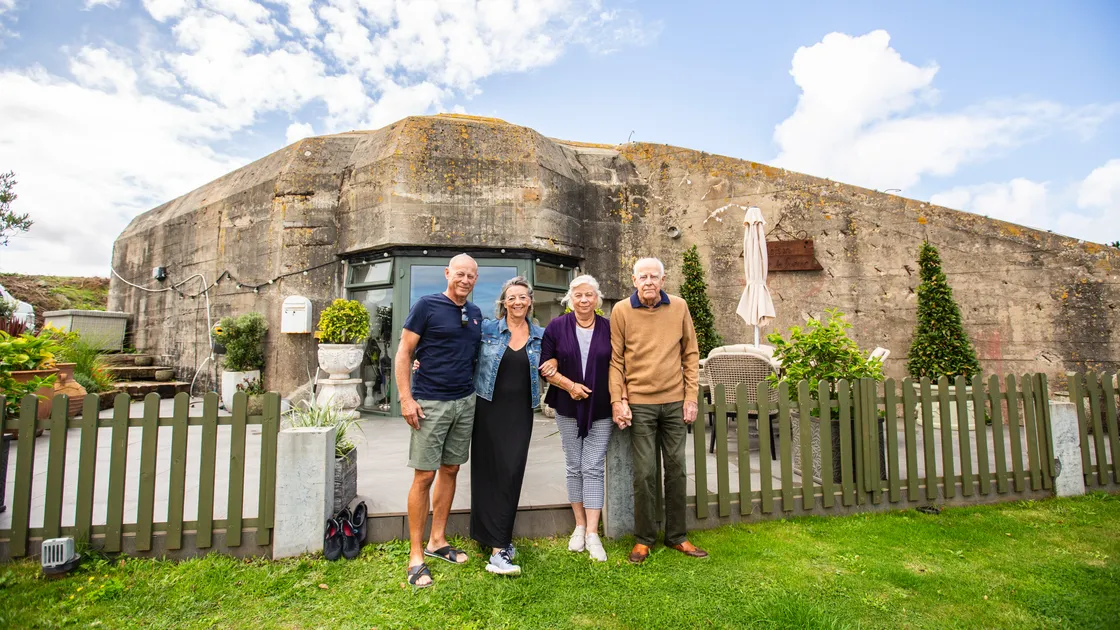
Sat outside Mark and Karen’s unusual but beautiful Occupation-era bunker home, overlooking the sweeping bays of the west coast on a glorious summer’s morning, it is hard to believe that 12 months ago they feared losing the lot amid one of the longest-running and most heated and public land disputes in recent Guernsey history.
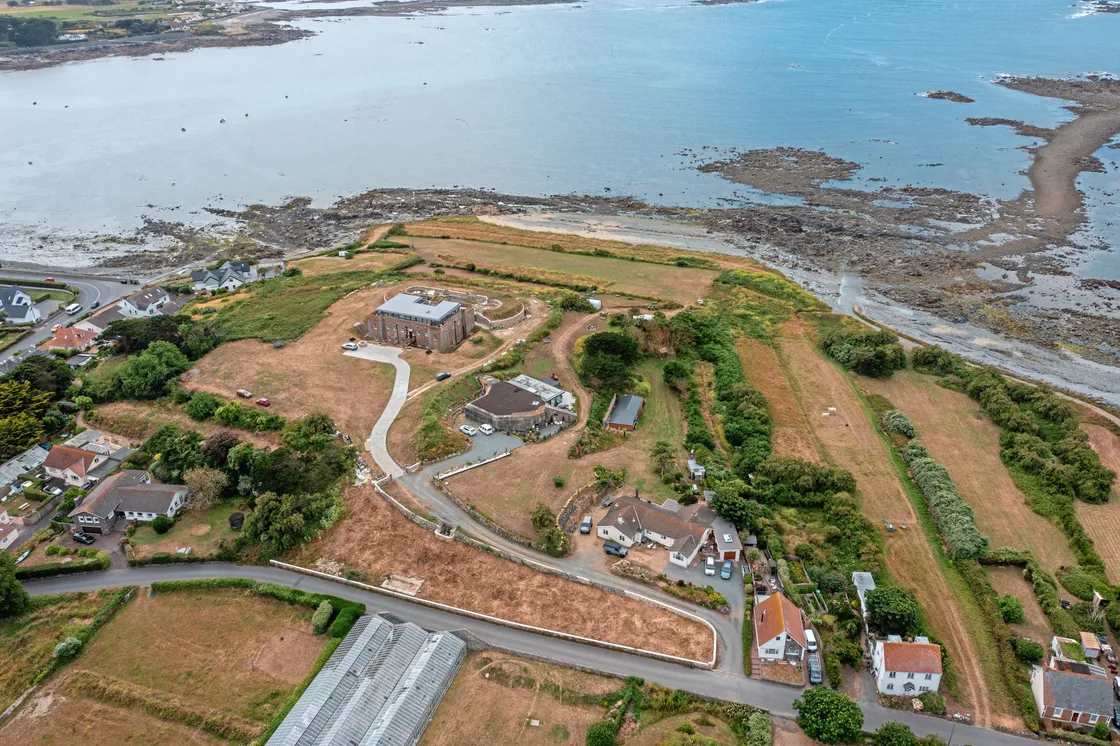
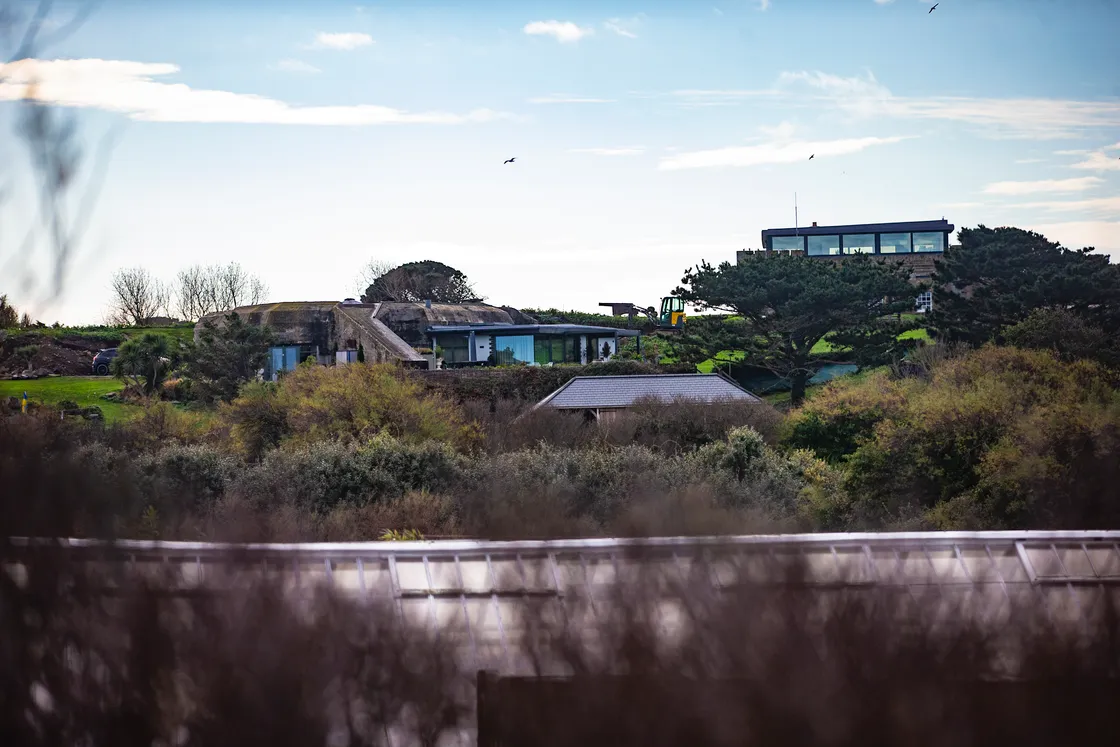
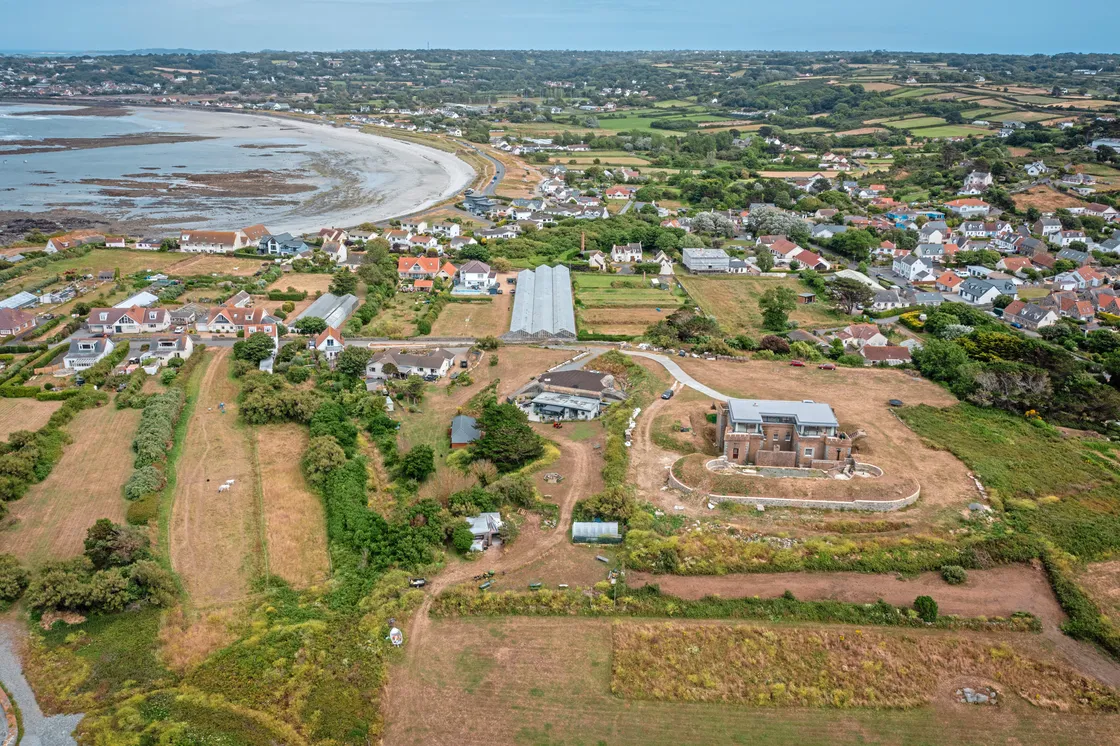
At that time, their neighbour, Jules Mountain, was trying to evict them from their home, Maison de la Guerre, a portion of which the States had bizarrely included in the deal to sell him the fort itself at the knockdown price of £1m. in 2019, five years after it had been marketed for sale for £2m.
The States had accepted years earlier that the Allez family were the rightful owners of Maison de la Guerre, but it nevertheless conveyed the southern part of the bunker home to the new owner of the fort, using a boundary map from 1922, which it knew was incomplete and had previously agreed to redraw.
The Guernsey Press broke the story behind the years-long dispute when it came to a head in 2024, as claims and counter-claims were filed with the court, the police became involved following an altercation, and the Allez family reached desperation in their bid to retain their home.
Eventually, as the court cases neared, there was a breakthrough when Mr Mountain agreed to convey the disputed portion of the property. The fight had cost them tens of thousands of pounds, but late last August the Allez family finally secured clear title to their home. They are not fully sure of the reasons for the breakthrough, which weeks earlier had seemed unthinkable, but believe the overwhelming public support they received following the paper’s coverage of their ordeal may have played a part.
‘We were getting nowhere until we agreed to share our story publicly,’ said Mark.
‘Once we did, there was this unbelievable outpouring of support from people. Everywhere we went, people told us they were appalled by what we were going through and they encouraged us to keep going. That helped a lot through difficult days.
‘We got there in the end. Today we are able to enjoy living here without the problems over ownership which dragged us down for many years and caused us so much distress.’
The States’ role in the saga at first puzzled and then angered the Allez family. They have filed papers with the court for reimbursement of costs totalling £80,000 in which they claim the States was ‘negligent, inept and careless’ to include a portion of their home in the sale of the fort.
They felt particularly let down because the States had allegedly reneged on a land deal made in 2013. The States secured from the family clear ownership of a key part of the access track to Fort Richmond, but the other half of the exchange, which was meant to give the family secure ownership of their home, was never completed.
‘We had to go through hell to reclaim our own home and the States should never have put us in that position,’ said Mark.
His dad, George Allez, who owns Maison de le Guerre and lives in another neighbouring property on the headland, has faced declining health in the past couple of years, undoubtedly aggravated by the immense worry about the future of the bunker.
‘The States has tried to walk away from the mess it created rather than at least making a contribution to what we had to do to sort out the mess. Even a simple apology for putting dad and the rest of the family through this would have gone a long way,’ said Mark.
In the last political term, the previous Policy & Resources Committee, which took over responsibility for property only after the 2019 sale of the fort, was repeatedly pressed for answers by former deputy Andrew Taylor, who left the States at June’s general election.
‘It was naturally disappointing that this issue wasn’t resolved before my term in office ended,’ he said last week.
‘On reflection, I don’t feel that P&R ever treated the matter with the level of seriousness it should have attracted.’
More than once he was left surprised at the response of the committee and its president, Lyndon Trott. He also suspected that the senior committee was doing little to verify or question its officials’ briefings on the matter, even after it was found to have published misleading claims.
At one point, P&R claimed that Maison de la Guerre was included in the sale of the fort only after the States received ‘formal assurances’ that neighbouring landowners were happy to deal with any boundary disputes between themselves once the fort was sold. The Allez family reacted swiftly, insisting that nothing they said or did could have given the impression that they were happy for the States to sell part of their home without first sorting out the boundary problems. Three months later, P&R admitted that no ‘formal assurances’ had been received from the family, and denied ever implying they had been.
Deputy Taylor felt vindicated in his consistent challenges of P&R’s version of events and accused the senior committee of being drawn into a cover-up. There was a time, not too many years ago, when the committee would have found itself under considerable pressure from other deputies, but these days such issues seem to capture few politicians’ imagination. The Scrutiny Management Committee also refused to become involved.
P&R’s main response was that the ‘legally split ownership of the bunker was a matter of public record’ for a long time and therefore it was reasonable to include part of it in the sale of the fort.
The Guernsey Press has now seen defences recently filed by the States against the family’s claim for reimbursement.
They contain few surprises – the land sold by the States was owned by the States, the Allez’ claim to ownership was unclear, and any distress and cost incurred by the family was not the fault of the States. They also cite an agreement, made a few weeks after the sale of the fort and previously hinted at by P&R, which it is claimed provided the family with £4,000 effectively to draw a line under the earlier unsuccessful boundary negotiations with the States and leave the issue entirely in the hands of the fort’s new owner and the family.
The previous P&R was confident that a court would find the States acted lawfully. The family, and former deputy Taylor, is hopeful that the newly-elected P&R will see that the States acted unethically, or at least unreasonably, and try to put that right.
‘I am hopeful that a change of faces within the committee will result in the States finally accepting liability for their obvious failings in the sale of Fort Richmond,’ said the erstwhile politician.
When the Guernsey Press submitted questions to the new P&R, officials said members had so far received only a fleeting briefing on the issue, and would be provided with more extensive information if and when the need arises.
The senior committee might like to ask why the States’ deal to sell the fort included part of a family’s home which was never going to be of any use to the fort’s new owner and could easily have been omitted from the 2019 conveyance without reducing the proceeds for the public purse.
And why an independent surveyor commissioned by the States in 2014 to clarify the boundaries around the fort, and who repeated the exercise early in 2019, provided detailed maps which placed the whole of the bunker on the Allez family’s land and not on the fort land then owned by the States.
And why a March 2015 memo from St James Chambers, the States lawyers, to States Property Services provisionally endorsed the boundaries on the independent surveyor’s map and stated they should not be contentious to the States.
And why, around the same time, the Treasury & Resources Department, a predecessor of P&R which was responsible for property, wrote to the Allez family confirming the States’ position.
It said then: ‘The surveyor has recorded the Guernsey grid co-ordinates of the points so that in the event that the physical points on the ground are lost they can be easily reinstated. This will result in confirmation that the entire bunker, as far as can be reasonably confirmed, will sit within your boundaries.’
And why the sale of the fort, including the family’s bunker home, was based on boundaries on a rudimentary map drawn 20 years before the bunker was even built, and which St James Chambers described only as ‘indicative’ just two days before the sale was finalised.
The States says that legally the ball is now in the family’s court. The family say that morally the ball is in P&R’s court.








You need to be logged in to comment.