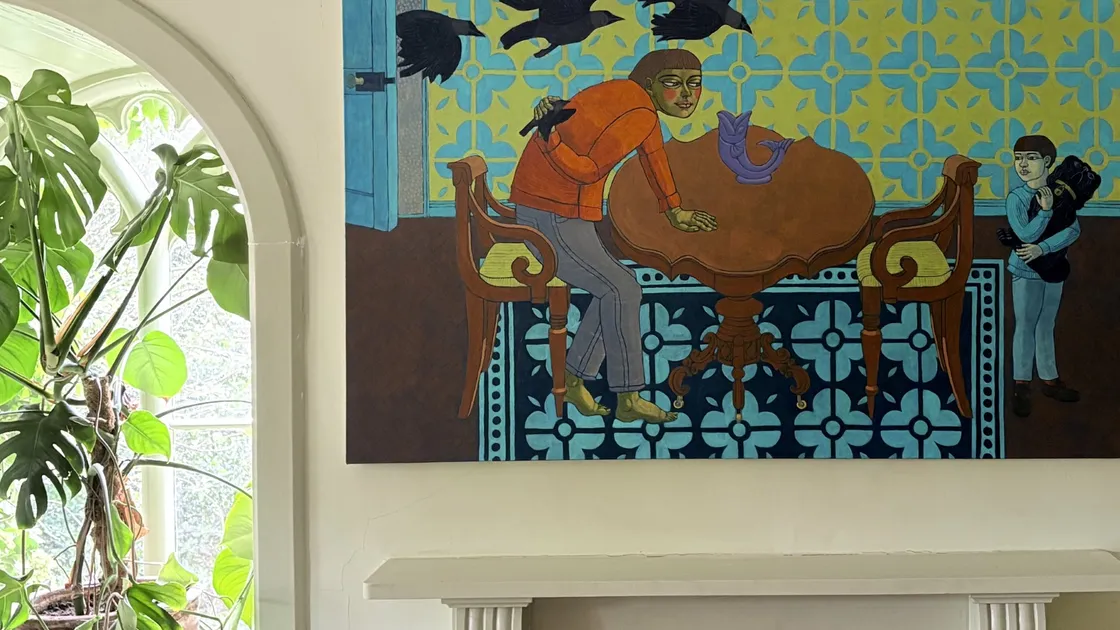
Response by the Split Collective is currently taking place at the Gate House Gallery, Elizabeth College and St Peter’s Rectory.
Split Collective is a group of 80-plus painters and sculptors from the UK, Ireland, Europe and the US, formed during the Turps and MASS correspondence courses of 2024/2025 and artists involved in the Turps/MASS onsite programmes in London, Margate and East Sussex.
‘We met when we were on the correspondence course,’ said local artist, Split member and curator of Response, Fiona Richmond.
‘We put on three exhibitions in the UK last year and we found some good venues. We quite like the idea of different venues – quite often exhibitions are very London-centric, but we did a big show in Wrexham in Wales in a former Asda supermarket building, one in the village of Standish, just outside Wigan, and then down to London for a weekend in August.’
Because of the collective’s love of unusual locations, Fiona suggested Guernsey.
‘Adam [Stephens] was keen to show our work at the Gate House Gallery and Adrian [Datta, rector of St Peter’s] has always loved art and loves the community aspect of art.’
The rectory also opened as a gallery last year for the multi-artist, multi-discipline exhibition, Exile & Return by the Occupation Arts Collective, which commemorated the 80th anniversary of Liberation, of which Fiona was a part.
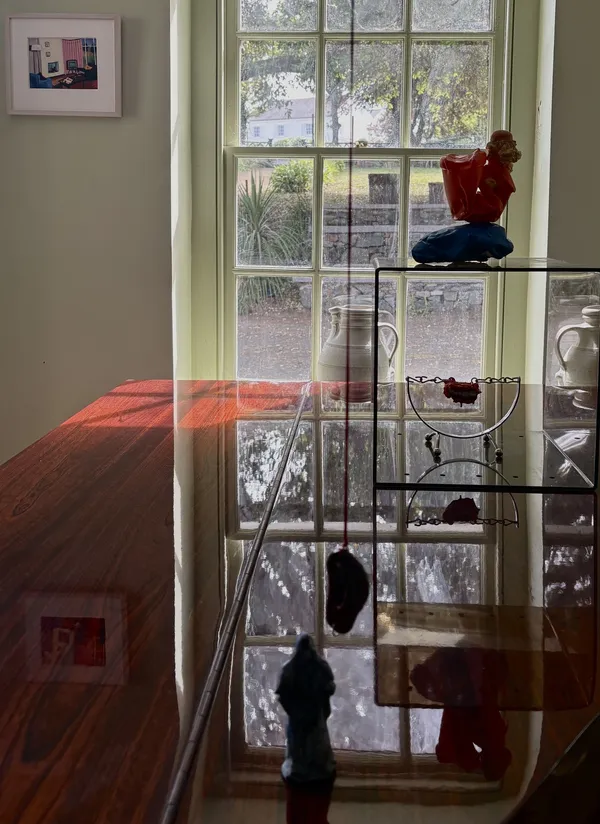
Describing the exhibition’s title, Response, Fiona was inspired by a quote in Helen Martineau’s book, Prodigal Daughters: ‘An artwork is not complete until it is received by others. Art lives in our response. The spectator, the listener, is as important as the doer.’
‘The work by the Split Collective is so varied, with so many different approaches, it had to be a broad brief.’
Fiona has three paintings in the exhibition – Pathway Through The Sea Beat To Port Grat, Le Guet Watch House Diptych and The German Stone Crusher.
The walls of the Gate House Gallery are packed with work. I met three of the artists, Amanda Horwood and Alexandra Helm, both from London, and Robyn West from Buckinghamshire.
‘There are 80-odd members of Split, but sculptors are in the minority,’ said Robyn. ‘But it’s great that the collective is inclusive and embraces all disciplines – sculpture enhances painting and vice-versa. There’s a great generosity of spirit in the group.’
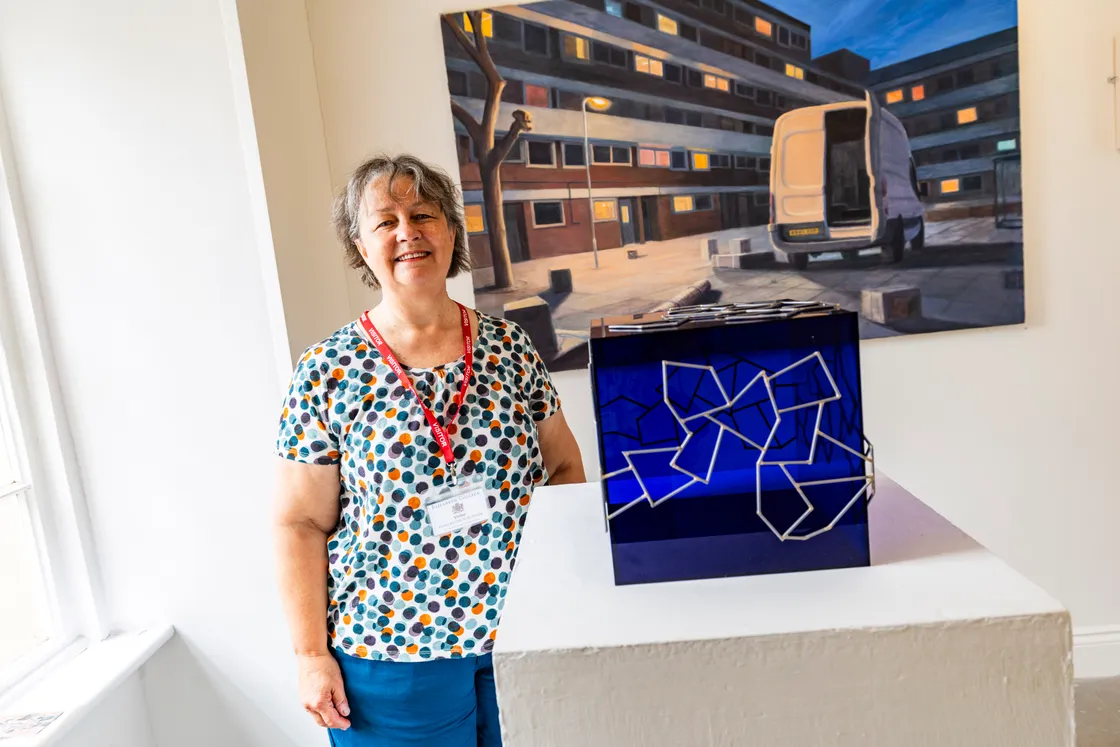
Robyn has three works in Response.
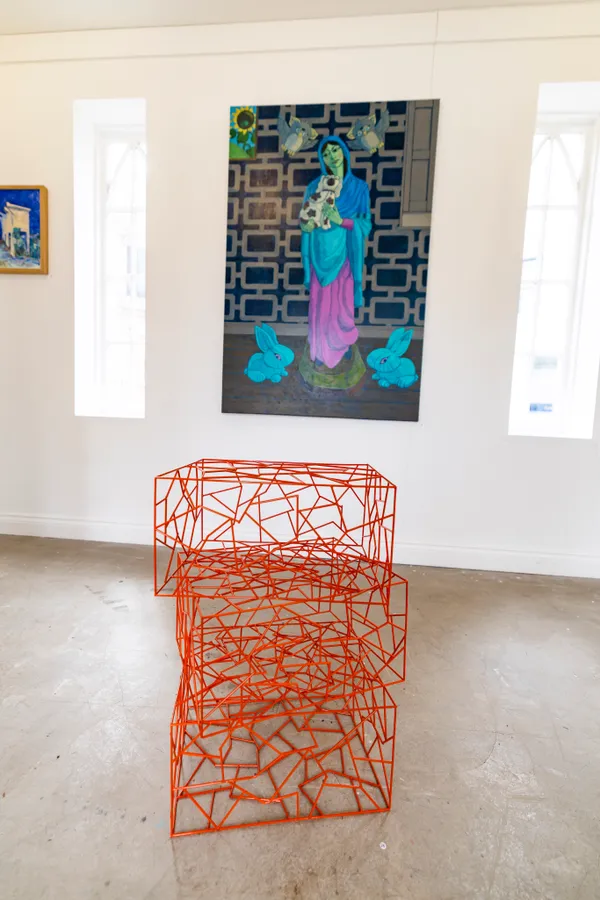
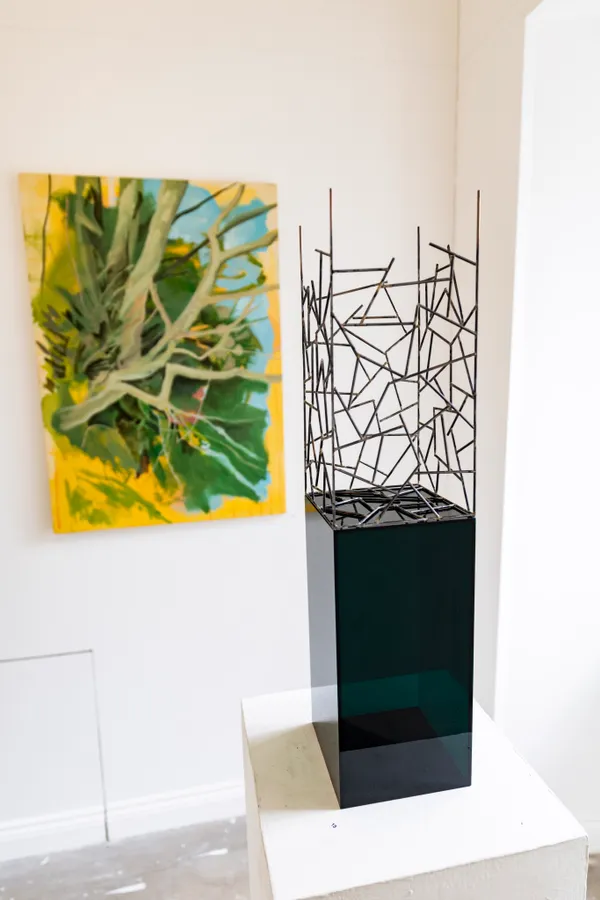
‘My work is inspired by architecture, industrial structures and stained glass – structured support steel like pylons and cranes.
‘I love the illumination from stained glass. That’s my main field of reference. I also play with texture, blasting back to bare metal so you can see the solder. I use coloured perspex as glass is too tricky to work with in 3D.’
Robyn made the piece Tracery 1 specifically for Response. It’s positioned perfectly on a plinth in the Gate House in front of a window.
‘It combines colour and steel framework. I’m always looking at creating celestial work, I won’t use artificial light, always natural light. LED lights are bright but flat and dead. So for me natural light is all. I appreciate seasonality and transience. I’m really pleased how this piece worked out.’
This is Amanda’s first time in Guernsey although she exhibited in Jersey last year.
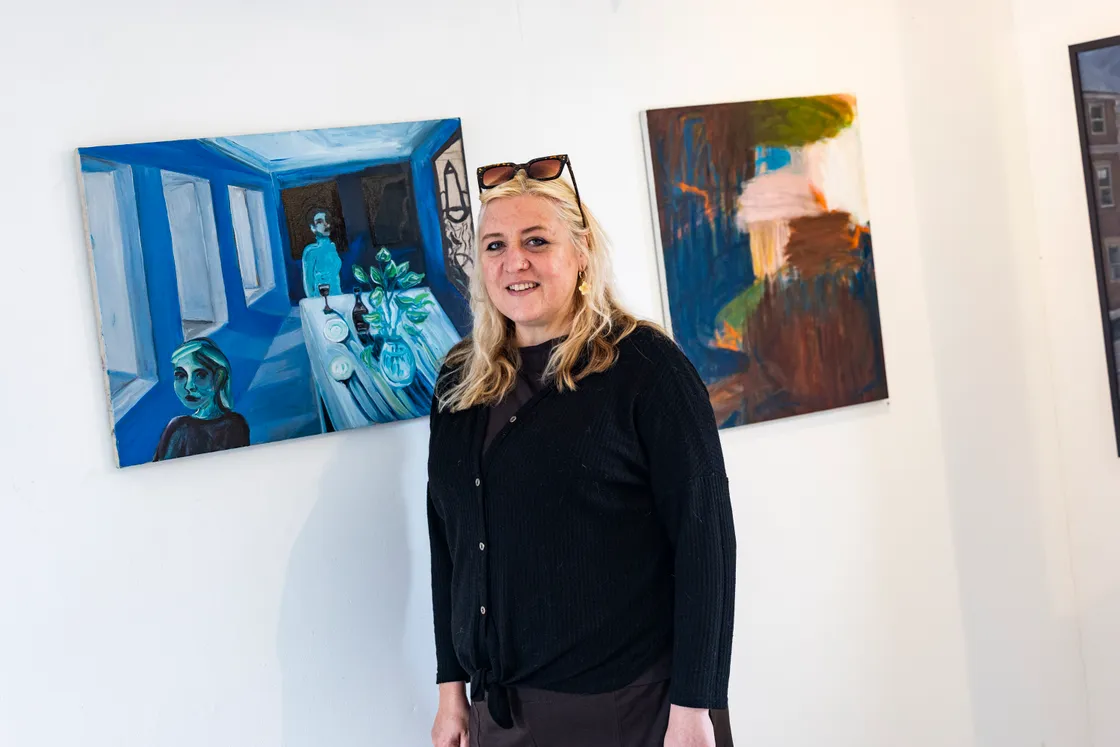
‘I have two works in the exhibition – one here, called Blue Room, and one at the rectory called Remote.
‘Blue Room is the direct result of talking to my mentor on the course, who encouraged me to work with memories and dreams – the subconscious.’
She explained that for her, the painting process has developed into a visual language for storytelling.
‘I’ve left a part of the linen unpainted with an outline of a tower. In tarot, the tower represents destruction, change and rebirth, which is unsettling to dream about. We just don’t know what’s going to happen.
‘The different zones – what is real, what is subconscious – all things happen at once.
‘The past and the future, and how we deal with it, is a big part of my work.’
Dreams and memories are also the basis of Alexandra’s work. For her large painting, she asked me what I could see (the first time an artist has ever asked me).
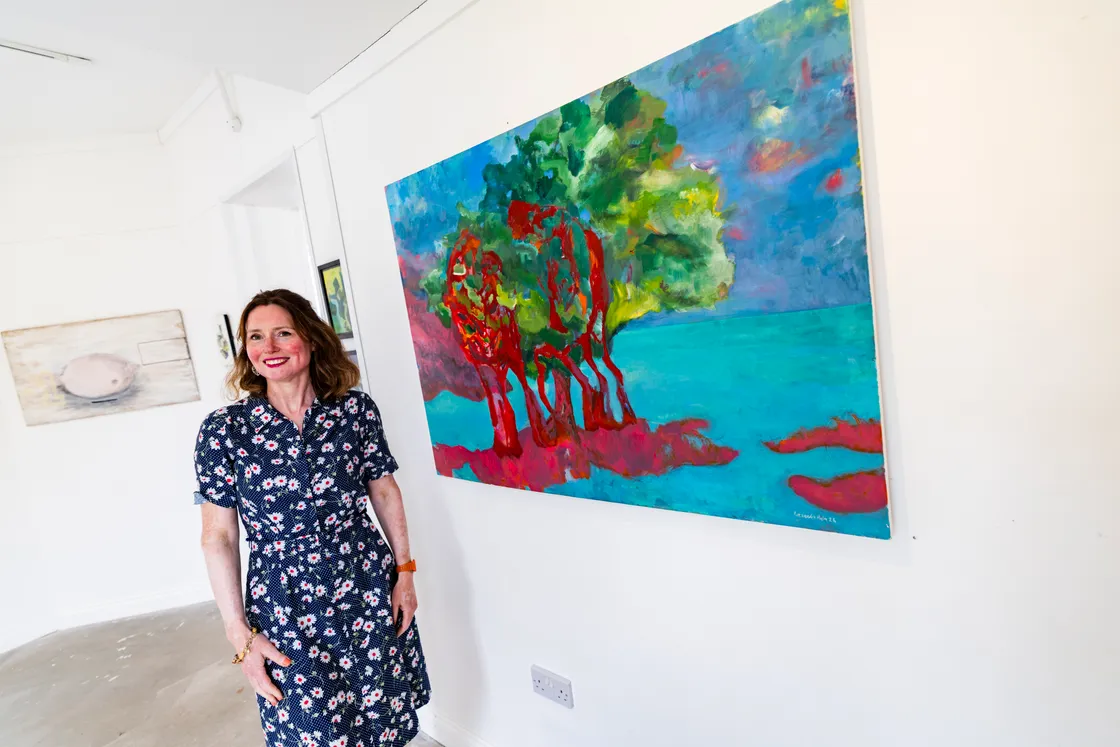
I told her I saw trees on a shoreline, but overlaid with an outline of some beast.
‘I dreamt about a pygmy hippo in an airport with suitcases. So for the painting I wanted to place it in a more organic location – attach to water and space and nature.’
Alexandra and Amanda had both been staying at the rectory while in Guernsey, and Alexandra had been painting en plein air.
‘The last two mornings I’ve been to Petit Port and Moulin Huet. We also went to Herm and ran to Shell Beach.
‘I love the colours of the rocks here – orange and pink and black and the blue of the sea. I actually used seawater from a rockpool to mix my paints.’
A beautiful Saturday morning and Adrian and his wife Myfanwy, together with the artists, were getting the rectory ready for the opening. White tablecloths and white plates of food.
I managed to speak to two artists, Arabella Ross from Hampshire and Martina O’Connor from Ireland.
Arabella’s work Entering Into The Golden Light is appropriately placed at the entrance of the rectory. A wonderful welcome to the many works within.
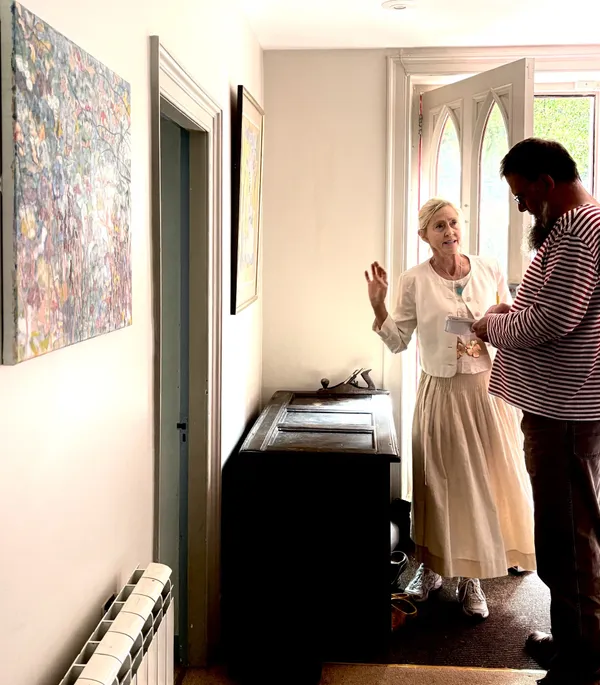
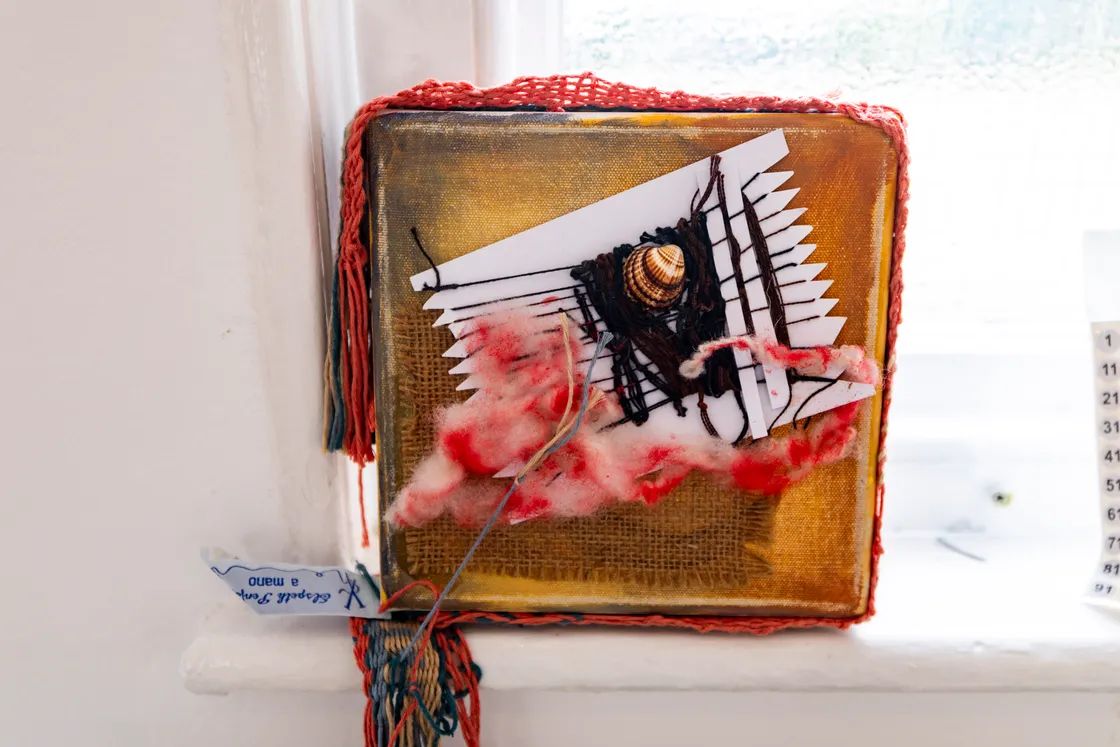
This collage is beautifully made with gold leaf, family diaries, postal stamps and markings and dried flowers and explores memory and identity.
‘I did a gold leaf course with City & Guilds and evokes reverence, hope and spirituality. I also used fragments of my mother’s stack of letters my father kept.
‘I spent a lot of time in India and this figure represents a lady next to a blue Krishna, travelling through to a Garden of Eden. There are also angels showing the quality of light. Light you can feel. They embody love and passion.’
Collage is only one aspect of Arabella’s practice.
‘I also paint in oils and produce drawings and ceramics.’
Martina is from Achill Island, off the west coast of West Ireland.
‘I usually work very large, sometimes two metres square, but that would have been a challenge to send over.’
Instead she is showing a small mixed media piece called Ode A Claude Cahun.
‘It’s part of a series on cotton paper. I have synesthesia, I can hear colours and shapes. They are overlapping sensations. When I paint it feels like I’m sculpting.’
Her piece at the rectory is in inks and watercolours.
‘It’s the idea of a face, like an explosion of energy from within. I chose Claude Cahun as she was an artist living in Jersey when it was occupied by the Nazis. Sometimes there’s a socio-political dimension to my work. I’ve lived in Amsterdam and I was interested in education under the Nazis.’
She said how much at home she felt in Guernsey and described her own home island.
‘Achill is the last stop before the US. It’s roughly just over twice the size of Guernsey but it has a population of only 2,500.’
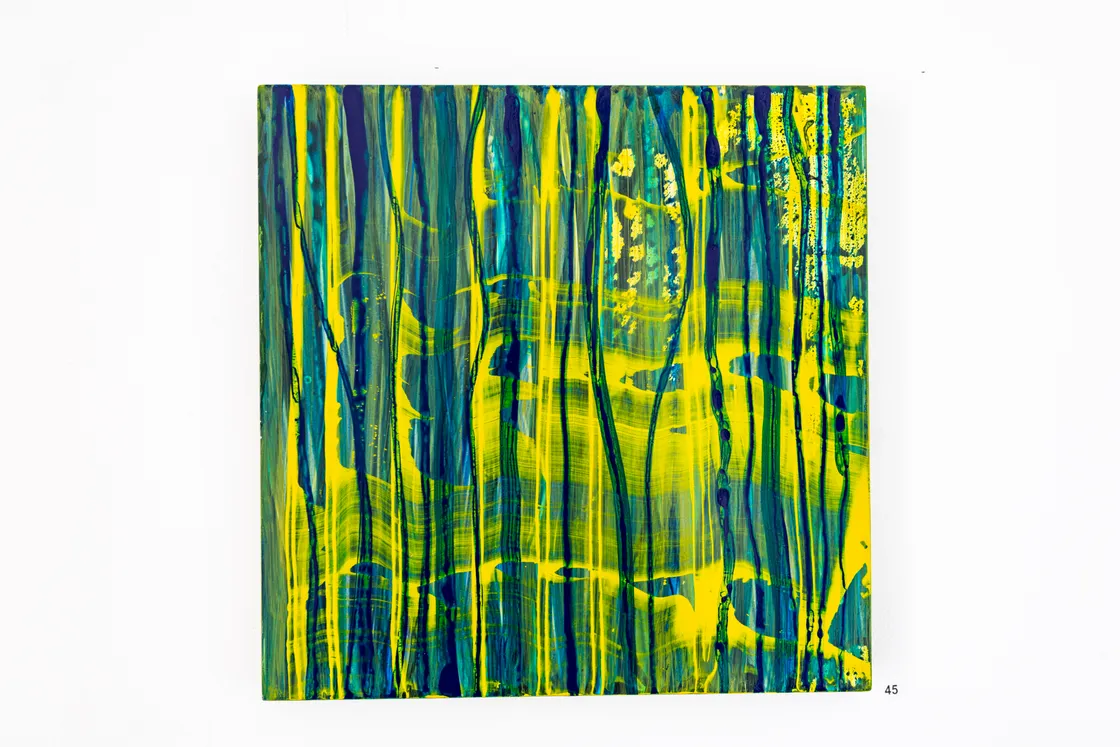
Adrian Datta said it was a pleasure to host Response at St Peter’s Rectory.
‘Every day and in so many ways we are all presented with a myriad of sensory invitations that enrich our lives. It is perhaps the gift and skill of the artist that seeks to capture and express a response to these stimuli.’
‘Hosting artists of this calibre is vital for the continued growth of our cultural landscape,’ said Adam Stephens, director of the Gate House Gallery.
‘By bridging the gap between the UK and the Channel Islands, and other countries, we provide our community with direct access to the evolving dialogues of the modern art world.’
As a reporter, it was great to meet the artists of the Split Collective and talk to them about their different approaches. More than just a group of artists, enthusiastic about their own work but also the work of others in the group, they seem like genuine friends. And Response – eclectic, fascinating, diverse and thought-provoking – is above all, a celebration of art itself. I’m hoping that the collective returns to Guernsey.
Response by The Split Collective is at the Gate House Gallery on Saturday and Sunday 6 and 7 June from 10am to 4pm and at St Peter’s Rectory until Sunday 16 August, open weekends only from 10am to 4pm. Fiona Richmond will be at the rectory this Saturday and Sunday to talk about the work.