

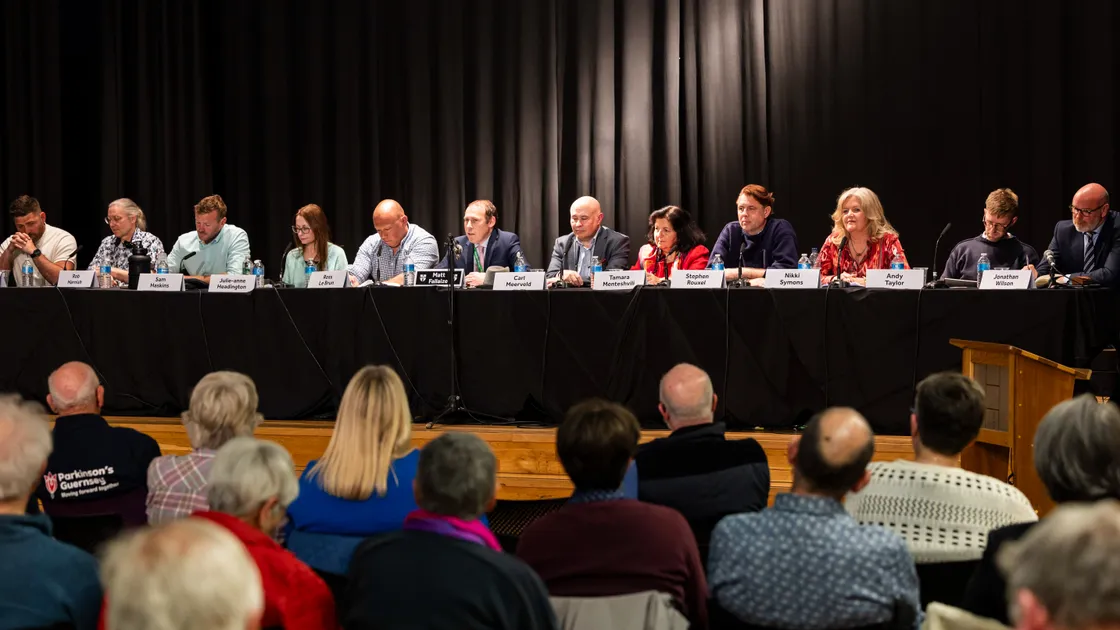
The Health & Social Care budget for 2026 was increased last year by 3.4% rising to £261m. to meet the ever-increasing demand-led pressure. In January this year, the States committed to achieving a 1% real terms annual reduction in budgets for the next three years, 2028 and 2029. If you were on the Committee for Health and Social Care, would you propose to achieve this by cutting services or increasing charges? If so, which services and charges? Or do you have another solution?
Luke Graham: If you’re coming here on a short-term working permit then you can’t just use our system if you’re ill. We want healthy people who are good workers, not people who are ill. They are costing us money.
Rob Harnish: In 2014 the Supported Living report gave us three quick wins. Only one of them has been implemented. AI diagnostics is going to be absolutely crucial for every jurisdiction dealing with an ageing population, and we also have to listen to our public health lead and strengthen our public health strategies.
Sam Haskins: This problem is compounded because you have medical inflation that is over and above inflation. One of the things that I that I am hopeful of is AI that can bring down health costs in general. Helping people stay in their homes for longer is something that I do think we need to really focus on.
Julie-anne Headington: I wouldn’t recommend any cuts. I’d work within the current budget. We need to progress the Supported Living and Ageing Well strategy, and support our elderly, keep them out of the hospitals. Also with the primary care review, look at this £12 subsidy that the States assists with. Is it still fit for purpose?
Ross Le Brun: I wouldn’t support cuts before we look at something like moving away from agency fees. That’s probably one of the biggest costs that health has got. We need to train our own nurses and incentivise that as a career option, and help them with housing as well.
Carl Meerveld: Costs are going up and I want to see HSC look at different ways at delivering services. People have suggested we contract organisations outside of Guernsey and fly patients to other locations for operations, whether it be in the UK or around Europe. There are ways that we can deliver a better service.
Tamara Menteshvili: I would particularly like to see care in the community to keep people in their homes. I want to see a more constructive cooperation in partnership with the volunteer sector that would reduce costs and keep expertise here on the island. I wouldn’t support cuts at a time when demand for service is increasing.
Stephen Rouxel: I couldn’t possibly comment on cuts, because, much like the committee themselves, I have no idea what services they provide that are critical. I’d like to see more prevention, I believe that is currently underfunded, and I think prevention is really necessary to drive down things like obesity and smoking.
Nikki Symons: With an ageing population, there’s going to be more demand on health. I think it’s about being smarter how we work and being more efficient, at more preventative care, social prescribing, and using partnerships, I wouldn’t actually support any immediate cuts to budget on health.
Andy Taylor: I wouldn’t support cuts at a time when demand for service is increasing and forecast to increase exponentially over the coming years, where I would see potential savings would be in new medicines that come to market, and checking those really carefully to see where they are going to be cost-efficient to administer.
Jonathan Wilson: Health is where some of the cuts will be if we don’t fix the deficit structurally. I wouldn’t advocate stripping back any health care or any of the services that we provide, but I think we need a working age population contributing to the system.
A raft of civil servants and public sector service staff have been able to be accommodated at the Les Varendes site, where apparently there was no room to plan to upgrade a purpose-built sixth form facility, resulting in the sixth form, Guernsey’s future, moving to La Mare de Carteret for seemingly an open-ended number of years. Can the candidates provide a view how this has been allowed to happen, and whether they believe a purpose built Sixth Form Centre should be built at Les Ozouets campus?
Graham: Kids don’t know how good they’ve got it nowadays. We need to stop thinking about building new schools and new special sixth form centres. We need to make kids resilient, not sitting in super air-conditioned, beautiful places. We should just keep it as it is and work with what we’ve got.
Harnish: If we actually want to deliver on a single, Sixth Form Centre according to the mandate, there are other options. Some of the best schools in the world are in grass huts, and I think we might be focusing in the wrong area. Put the money into the people.
Haskins: There has been too much political interference in the whole of the educational system. The whole system needs stability, and I’m very pleased with my role on the governing boards, I’ve had teachers tell me just how much stability that those are adding, and they’re focusing on outcomes and not buildings.
Headington: I wouldn’t have moved to La Mare I would have kept them at Les Varendes. We need to ensure that our children are in environment where they can thrive, and moving them around the island like pieces on a chessboard is not good enough. A decision needs to be made and stuck to.
Le Brun: In 2020 people actually voted for what we’ve got now. If we want to change things, it’s going to disrupt things again. If we’re not happy with where the sixth form is, it’s going to be, need to look at the model again, because we can’t afford to build the new Sixth Form Centre.
Meerveld: I want to see the students get their Sixth Form Centre back. I’d like to see the civil servants move to a different location. I’d like to see a split campus between the Ozouets site and the Les Varendes site, with a short walk in between, just as many universities in the UK do.
Menteshvili: I don’t think for a moment that we can look at it as a holistic problem. We have buildings that are failing us. I’d like to see a mixture of apprenticeships and other types of initiatives to take the young adults, away from one vocational path or an academic path, and integrate them more socially.
Rouxel: It was an election mandate that was given to the last ESC. I think what we really need to be concentrating on is educational strategy with educational pathways. If we want better education, we need to be listening to our teachers and forget about the real structural problems.’
Symons: I was in favour of a Sixth Form Centre being built, but with the ever-expanding costs of the project, I now don’t think that the government has the money to put into that. Costs have gone through the roof, and we then can’t afford it. A lot of it is about being much tighter and careful with budgeting, planning and project management.
Taylor: It’s a disgrace the situation we find ourselves in, but in the face of declining pupil numbers, I don’t think the answer is in a newly-built Sixth Form, given we have three private colleges offering post-16 education, and they’re facing the same issues. It may represent an opportunity to find a mutually beneficial solution for the states and the private sector.
Wilson: We can’t fail our children. I think the Sixth Form Centre needs to be there. Why would we not allow them to continue in a sixth form centre, to do their A-levels and to be a part of building something within Guernsey that’s good, solid and gives them a foundation for life.
With so many young people leaving the island and with the young people remaining in Guernsey finding it difficult to buy a home and put down roots here, and the birth rate decreasing, what do you think the States should do to encourage young people to stay in the island and put down roots here?
Graham: If parents have got any sense, they’ll be educating the kids in the fact that this is the best place in the world, it’s the safest, it’s the most beautiful. It’s easier to stand out in Guernsey. So if our kids have got any sense, they’ll stay here and make a life for themselves here.
Harnish: Young adults move to pursue job opportunities and university places. We have to increase the attractive corporate offering and developing our university sector so that they’re actually university places that attract young people to learn, study and move into careers here.
Haskins: We all want the opportunity for a good job, to do something that we love, that doesn’t feel like work. We need to
look forward to the future and think we can see ourselves living there, with a partner and a house. Policies around that are important.
Headington: We need to grow our own, with apprenticeships and in-house training, and for those university students, some sort of relocation package to bring them home. A Guernsey property savings tax to help them towards renting or buying, or scrap document duty.
Le Brun: Supply isn’t keeping up with demand. We can’t wait for the private sector, and I do believe that the States should become a developer again with States housing. I do have an idea for affordable housing to buy, start at home units that could be done by the States.
Meerveld: They have to be able to see that they’ve got a future in this island, that they can have the lifestyle that most of us have enjoyed. We need to diversify the economy and create more well paying jobs outside of finance. They need to be able to know they can buy a house or rent a property relatively cheaply.
Menteshvili: I would look at guidance and available resources to steer youngsters into a career path. There used to be all sorts of career, apprenticeship-type meetings with industries, whether it be construction, finance, nursing. I think skills development, and a structured initiative for wellbeing are important.
Rouxel: Kids have been leaving for many, many years. We need to create opportunity, which is why I’m calling for a change to the high net worth, tax cap to require investment into start-ups, small and medium-sized enterprise start-ups for those university students returning for an opportunity to grow within the island.
Symons: We could start slightly earlier while children are in sixth form and opening up more opportunities for them to do work experience in some of the big companies over here, so if they do go to university, they’ve still got that in their mind to come back. They’ve already forged a relationship with a company over here.
Taylor: The answer to maintain them or keeping them here is to provide a future. That can be done in many ways, through affordable housing and employment opportunities, but perhaps that’s a problem we will never solve. So perhaps we’re better off embracing them leaving after all?
Wilson: We are a small island and we can’t cater to everybody. The aspiration is to buy a house, to bring up a family here, but is it possible? There needs to be something aspirational for us to look forward to, and for the kids to look forward to something, and to feel like they are part of something.


You need to be logged in to comment.