

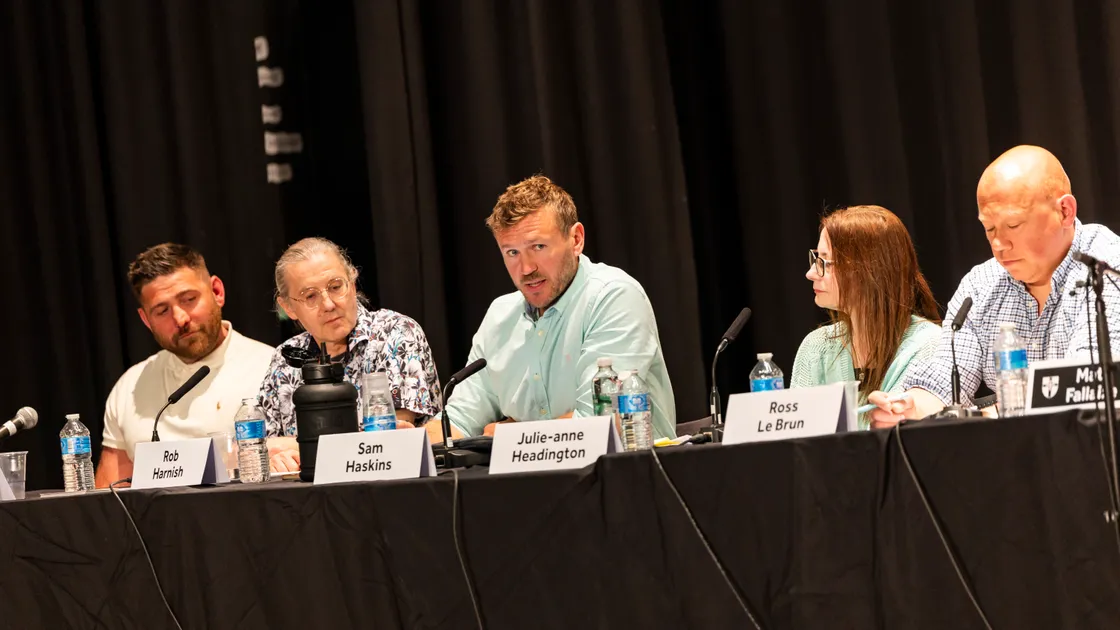
How do the panel members think that the Guernsey people can be convinced that GST is the right way for us to go?
Luke Graham: There’s much better ways of doing it. The big players are making their money here, Guernsey gives them financial advantages. We need to realise how good a place this is. It’s the best place in the world. We need to treat it that way, if anyone wants to be here doing their thing, we need to charge them for the privilege.
Rob Harnish: GST is regressive. It affects the poorest most. I don’t support it at all. The plus is offered as a short-term fix, and it’s absolutely not sustainable. We need to bring that income in, but we need to bring it in sustainably, that means either territorial tax or income tax or a business tax.
Sam Haskins: I’m not sure they can convince you, definitely not right now, because of all this waste that’s going on. What people are asking for, is where there’s too much waste, why aren’t they looking at that and it’s clear because there is not enough accountability in that.
Julie-anne Headington: I’m not in favour of GST, but we need a long-term plan to fix our financial situation. I don’t think it’s fair to put the burden on the current workforce and tax them more, because our workforce is shrinking. Whatever the plan is, we need a fairer tax system that protects the middle and lower income earners.
Ross Le Brun: I’m not convinced GST is the answer. I’m more against public services reducing than I am against the new tax because someone’s got to pay for it. It’s wishful thinking to think that we can turn around the economy that fast, that we’re going to get the money we need.
Carl Meerveld: Most people here know I have opposed and fought against GST since day one. I want to fund our services through economic growth and diversification, not increasing our tax take. I am not convinced we have a black hole of £100m. Nobody can read the States accounts, no accountant can tell me what the deficit is.
Tamara Menteshvili: I’m absolutely dead against it. 15% corporate rate tax is now mandated across all OECD countries. That includes us. We’ve already signed up to it. There’s no cohesion to anything that I’ve seen to explain where this deficit has come from when we’re sitting on billions worth of things that could be securitised.
Stephen Rouxel: I would be a no to GST unless I’ve got several things here, such as growth and investment into small and medium-sized businesses through a change to the tax cap that would see us funnel the money required to get access to the tax cap and invest it into a Guernsey domiciled fund managed by fund managers safeguarding the economy.
Nikki Symons: GST is already on the table. The current sitting deputies have already put their mind to it and are now looking at the corporate tax review that’s coming out shortly. We have such a big black hole of £100m. that any other options we’re putting forward at the moment will just take too long to fill that hole.
Andrew Taylor: We probably should have started trying to convince you about two years ago. I don’t disagree about wastage and inefficiencies, but they pale in significance to the amount that we need to be raising. It’s got to be an ‘all of the above’ approach. We need to make those savings but we still need to increase our revenues.
Jonathan Wilson: I wouldn’t try to persuade you to vote for GST at all, until we look at things like growth and investment. It doesn’t work at all. We’re looking at a £56m. deficit. By the end of this year, it might be closer to £100m. GST isn’t coming in until the first quarter of 2028 so by then it might be £200m.
If you’d been put in charge of the States IT Agilisys project, what specific actions would you have put in place to ensure that the project was delivered according to the tender, on time and within budget?
Graham: I think all the overspend in the civil service is to do with this woke ideology of where you can’t raise your voice anymore, because if you do they’ll get signed off work for two weeks. They’re all scared and I would be as well if I was employed by the States, because you’re going to get suspended or whatever.
Harnish: The two key words are responsibility and accountability. Responsibility is forward-looking, accountability backward-looking. The chief executive has taken responsibility. I’m concerned that just imposing structural changes to create accountability won’t be enough without the culture change I stand for. Those who have made wrong choices have to be held to account.
Haskins: In the procurement there was unclear definition of responsibilities. If everyone is responsible, then no one is responsible. There wasn’t a culture of challenge. I definitely am very analytical and pretty good with numbers. I will ask, and I will dig deeper.
Headington: I ran my own business for over 20 years, and I’m appalled by the state that it’s got into. I would have had regular meetings. Look at the expenses, look at the budgeting, look at the time plan, and if they didn’t get to a certain point within the time frame, why not?
Le Brun: I think what it would have needed is a central project manager to actually overlook the whole thing. From what I’ve read, it was managed between lots of different groups, it was very disjointed. I’m not going to pretend I have managed a project of that size but it needed some better central management.
Meerveld: Agilisys is just one example. We’ve seen the MyGov project and tax service upgrades, the civil service are not capable of running projects in a commercial way. I’d like to think we have incredible resource in this island of the entrepreneurs with incredible business skills willing to volunteer their time to help oversee and manage this.
Menteshvili: This is not the first time that we’ve seen a project that is not fit for purpose. If legally, they’re held to account on the delivery of whatever service they’re providing, whether it’s in this instance, any overspend is down to them, not down to you as taxpayer. It’s the legal framework under which any procurement is done.
Rouxel: I think the main issue they had was in the tender process and poor governance. When outsourcing, they didn’t follow the simple 80/20 rule, you can only outsource 80% of anything that you do. You need to retain 20% of the oversight to ensure that things are done properly. The big word here missing is accountability.
Symons: Projects are spread too thin around too many different people and too many committees. For me, it’s about refocusing that and about having people who are experts in their field actually project managing these massively expensive projects. I think much stronger project lines and management, senior management should have nipped it in the bud earlier, instead of letting the project overrun.
Taylor: I don’t think there’s anything I could have done. I think the desire and the aims were completely unachievable. No one at the time appreciated how poor and how behind our IT services were. We were trying to we’re trying to do too much in one go. We just bit off more than we can chew, and it’s bitten us in the backside.
Wilson: The contract needed to be specific, measurable, delivered on time. The suppliers should not have been on the board of the company that assessed the suppliers. If it was the States of Guernsey law officers that signed off on the contracts, they should have gone through these contracts on a timely basis, and looked at governance on a periodic basis.
Guernsey isn’t getting any bigger. Do the people who hope to be States members agree with the present States policy that the economy should be increased by increasing the population with non local people?
Graham: We’ve already got a population problem. Guernsey is already losing its heritage, and it’s not going in the right direction. And that’s exactly what I stand for.
Harnish: The ideal population size depends exactly on your view of what the ideal island lifestyle looks like, and what our ideal economy is. We lack a vision for a sustainable economy. At some stage you have to say this is what a healthy, sustainable economy looks like that fulfils all of our needs and makes this the most wonderful place to live.
Haskins: There is an element of immigration that we will probably always need. I do support the urgent review, and I think I’m edging towards a more skills-based, or the very least targeted immigration,
because the cost of increasing rents is so much.
Headington: We don’t know how many people are on this island. There is no overarching body that controls immigration, population management, tax and health. They don’t talk to each other. So when people are coming in, are they even doing the jobs that they’re supposed to be doing? I think some people are being exploited, but from a local perspective.
Le Brun: We’ll always need incoming staff to cope but I never agreed with using population growth to increase the economy. It’s basically a pyramid scheme because the more people who come here, the more public services they need, and it puts demand on everything, and not just in the future for care, but right now on the utilities, on the roads and everything.
Meerveld: I don’t agree with the States immigration policies at the moment, you cannot grow your economy by importing people. We’re increasing the density of population, but those people that we import will then get older and demand those same services in their retirement and medical services, etc. You need to increase the productivity of the island.
Menteshvili: I came here on an essential licence to bring a skill set that wasn’t here. It was a tremendous opportunity for me. Sometimes you do have to import talent. But none of these people can come here without a house to live in – maybe we can bind that with the employers who take them on to that they can actually provide housing coverage and costs.
Rouxel: We’re never going to be able to get a get away from bringing in some people to do some jobs, but we do need to establish a maximum population load that the island can accommodate. This number needs to be dynamic. Maximum load should consider economic needs and social acceptance.
Symons: We need to decide what Guernsey is and what we want it to be, and how many people we expect to come in to live here. I don’t think at the moment it’s clear, it’s very reactive. But there are certain jobs and skills that we need.
Taylor: I have some concerns that we’re aiming more for workforce size, instead of considering the best value, what is each worker contributing to the island? There are roles that the island cannot fulfil itself, but we need a much more considered approach to how we decide who can get a licence.
Wilson: The dependency ratio is worsening, we have more retirees, fewer workers, rising care costs, and you can’t tax your way out of that demographic reality. We need productive people. The limiting factor is not who we want, it’s whether we have somewhere to put them a bed. So fix the housing supply is probably one of the first things.
If you are elected, all the committees are now filled, so what are you going to achieve?
Graham: ‘I didn’t support this election. I wouldn’t have done it. We’re not going to be able to make much impact because we’re not sat on certain committees. What I stand for is all to do with population, keeping Guernsey as it was.’
Harnish: ‘My whole campaign is based on my ears, your voice. You should never underestimate the power of the backbenchers, because they are the people that connect the people in the committees together. They’re the people who move from one issue to another and make sure that the services join together to meet real needs, and that’s what I intend to do.’
Haskins: ‘It is one of our jobs to research and it’s one of our jobs to reach out and gather as much opinion from stakeholders. Deputies don’t do enough, the principles of which I make decisions are fairness, integrity, accountability. I actually think the backbencher role is really important from an accountability point of view.’
Headington: ‘I’m standing with Forward Guernsey so I can support my party colleagues. I’ve been involved in the background in government for the last year, so I’ve got a knowledge of what’s going on. Having done the campaigning, I’ve heard some incredible stories and diverse opinions on what the island wants and what the island needs.’
Le Brun: ‘I would politely ask people that are sat on multiple committees if they would like to give up a seat to allow me to actually give an input for best value for the taxpayer, because it’s pointless me just being a backbencher as such. I know my ideas will need to be put as requetes and amendments, and I know that they need public backing.’
Meerveld: ‘I think the most impactful things I’ve done in the past were done as a backbencher. Campaigning against GST was done independent of committees. Campaigning for island-wide voting, coming up with the idea of a wind farm. You can contribute from that backbench role, in some ways more so than if sitting on a committee.’
Menteshvili: ‘I’m determined to meet representatives of the douzaines at least once a month. I think everybody who gets elected must sit on a committee, otherwise you’re a backbencher and you’re not adding value. I would attend every single meeting that’s offered before a States meeting.’
Rouxel: ‘I have a very long list of economic policies and other policy areas that I’d want to achieve. I’d certainly build on the existing networks that I have from lobbying on behalf of business for the last 10 years, the current deputies who are in the committees and working with them, I’d very much like to see quite a lot of change in the economic space.’
Symons: ‘I think the backbencher role has a lot to offer, and gives you an opportunity to listen and to question. I’d be really on that, and I’d offer myself to join the Scrutiny Committee. I’d look for project work. I’d look to join sub-committees, and I’d be open to join any committee at any time.’
Taylor: ‘I would put myself forward for any committee position that comes available. I like to research the issue, speak with the people that it’s going to affect, and try to explain to them generally in more depth, because I hate to say this, but most of the time, as a deputy, you understand the issue more superficially than a lot of the public.’
Wilson: ‘You can research and it’s part of my job to research things, coming up with what’s worked in other places in the world, planning ahead, longer planning. We can look at New Zealand. They look to plan infrastructure of various other things over 30 years, instead of our four locally.’
Are current sentencing guidelines for sex offenders and paedophiles appropriate, and are candidates’ views on this in line with what the population think?
Graham: ‘People who are touching children and ruining children’s lives get two and three years, while those bringing in a bit of weed get seven or eight years. It’s archaic and it’s disgusting. It’s absolutely disgusting as paedophiles walking our streets, I want to kill them when I see them.’
Harnish: ‘I worry that it’s very easy to have a gut emotional response to some issues, and paedophilia is certainly one of those, which means we don’t look at the cases close enough to make sure that the guidelines are being well applied, and that people who are being released are being released as they should be, because they are safe. Our prison service is about rehabilitation.’
Haskins: ‘It seems to me that sometimes it’s not fair and it’s not proportionate, it’s out of kilter. I do believe that many people in Guernsey are saying it doesn’t seem proportionate, and I think there’s a higher expectation. I’d have to look at it.’
Headington: ‘This is something that I’m passionate about, I work at Victim Support, and we log the sentencing results when someone was found guilty. There is no logic to it. They’re not strong enough. Every case should be held in the Royal Court where every sentence is above two years and the fine is above £10,000 and the sentencing policy should be looked at to increase those sentences.’
Le Brun: ‘Sentencing should be much harsher, but it also needs to be looked at because it’s clearly not a solution to the problem, because these people are hardwired to do these things. The UK have recently been looking at voluntary chemical castration, and I’d be open for something like that to actually take that drive away from them.’
Meerveld: ‘I don’t know enough about this subject about but I’ve never seen a policy letter in my nine years where deputies were asked opinions of sentencing guidelines. To me, that is something that’s done through the courts, and I don’t know enough about that specific subject but I’d be happy to look into it.’
Menteshvili: ‘There was a review in 2024 to ensure that probation is given or parole is given after a length of term is half of a sentence is served. So I think that was a very positive move, because that was a bit of an arbitrary application.’
Rouxel: ‘Without the sentencing guidelines, none of us would be sat here. I think that any sentencing needs to follow natural justice. There needs to be proportionate, fair and consistent, most importantly, consistent. My understanding is that current guidelines are based on UK case law and looked at on a case-by-case basis. So perhaps consistency is what’s missing.’
Symons: ‘It’s something to look very carefully into before we give an opinion on that. As a new States member you have to look into these things, and you learn on the job. Trying to have an opinion on this very sensitive issue at this point in this kind of environment is incredibly hard.’
Taylor: ‘I sat on the Home Affairs Committee last term, having an involvement in bringing before the States expanded definitions and changes in sexual offences legislation. Although politicians can have an influence in sentencing policy, I think any influence of politicians in the judiciary is something that should be exercised with extreme caution.’
Wilson: ‘I haven’t read the guidelines, I don’t know whether I’m aligned with the population on this at all. Obviously we think that they’re a blight on society, and they should get the book thrown at them. I think probably most of us think that. But proportionate, I don’t know.’
How would you sort out Guernsey’s public finances?
Graham: ‘I’m not so sure that we’re in as much debt as we keep being made out to be in. I think it’s been too many years of deputies getting in there and just wanting to line their own pockets and do what’s best for them by influencing and having a having a say, that needs to stop.’
Harnish: ‘Anyone who’s ever had a mortgage knows that debt isn’t always a disaster. The problem is making the regular payments to clear it, and that’s where we’ve fallen down. There was a time, particularly after the war, when we did need some money, and it wasn’t wrong for us to borrow. What we fail to do is pay back.’
Haskins: ‘The same problems have been going on a long time, and maybe that is the problem with consensus government. Let’s hope there’s not another war, because our taxes could go very high. I will do my best to cut waste, to make savings, to look for opportunities and to try and get us to live within our means.’
Headington: ‘Everybody on this island should be seen and heard and taken care of. I don’t know what the fix is, but if I get elected, I will do the damnedest I can.’
Le Brun: ‘The States of the past got very comfortable with the finance industry and left everything else, basically, or neglected a lot of other industries. I think we need to be looking at investing into other industries.’
Meerveld: ‘I’m very much of the generation of cut your cloth according to your means. I believe that you should try and avoid debt as much as you can, as an individual, as a company, as a government. It’s worth noting Guernsey’s level of debt is very low compared to Jersey and other other western governments.’
Menteshvili: ‘I would suggest an economic recovery plan, not just another plan, but something very specific, with very specific targets and timeframes and how it’s going to be implemented. The finance sector contributes 44% of our economic output, how can we help it to grow and stay? What about tourism and hospitality?’
Rouxel: ‘I’ve set out several times now what I think we need to do to invest into the real economy, into the construction sector, into technology innovation. I think we very much need to grow the real economy, and that will sort things out. Look after the pennies and the pounds will take care of themselves.’
Symons: ‘We’re back to this tax situation again, it’s been kicked down the can and down the road for a long, long time, repeatedly. Nobody really wanted to make the really tough decision of how we tax people further. I still think we’ve got a real issue about trying to raise those funds to fill that deficit in a quick, timely manner.’
Taylor: ‘I don’t think we’re the only society that is facing this problem, but we are in a fairly good position. We have a fantastic economy already, but that poses another problem that is difficult to grow the economy. It’s a bit of everything. It’s revenue-raising, it’s expenditure restraint and accepting that we might not be able to provide everything that we currently provide.’
Wilson: ‘The housing crisis, the deficit crisis has been a long time in the making, nothing has crept up and grabbed us without us noticing it’s coming. Let’s have a treasury function that works and considers local economic benefit. To stop money going off the island we need to invest, if they’re community-owned projects, if the States can’t work out how to invest long-term, maybe it’s time to look differently.’





You need to be logged in to comment.