

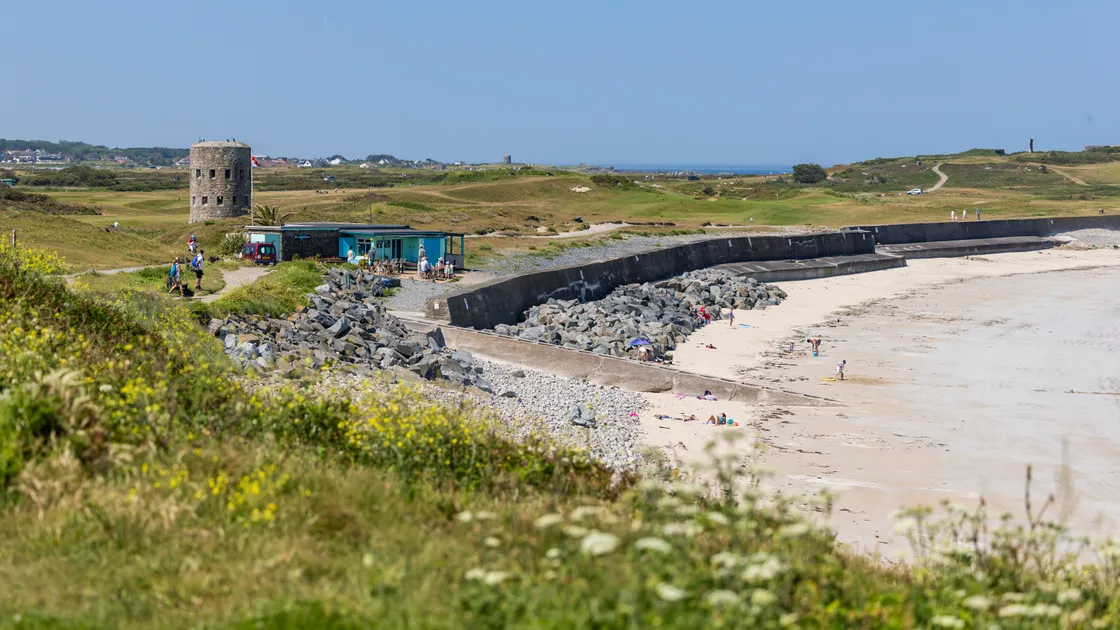
Recent work at L’Islet and L’Ancresse led to some islanders taking to social media to express their dismay at the cutting down of flowers in bloom.
These concerns were shared by National Trust of Guernsey president Mike Brown, who said he would like to see cutting delayed by at least a month.
‘While I am sympathetic to the need, for road safety purposes, for the cutting of hedges and verges, I believe it should be delayed a month to allow wild flowers to go to seed and young birds living in the hedgerows to fledge. I struggle with the need to make everything “tidy”. Nature is by definition wild and unkempt – that is part of its appeal,’ he said.
La Societe conservation officer Jamie Hooper said the recent mowing of land along L’Ancresse Road was disappointing. ‘Spring flowers such as Lady’s Smock were in full bloom so these plants have effectively lost a whole year.
‘If such areas are repeatedly mowed when in flower, the rare plants and the wildlife that depend on them will be lost.’
However, he said the impact on mowing depended on the site and while some areas would be all right to be cut now, it could be detrimental to others.
‘For example, some coastal areas would benefit from an earlier cut as this can encourage late-season species and will also reduce species such as bracken and bramble.
‘However, grassland with plants such as orchids are best left until those important species have set seed.’
And if everything was cut back at around the same time, that could lead to a problem for the wildlife which would have nowhere to go, he said.
The annual ‘No Mow May’ campaign was started in 2019 by UK conservation charity Plantlife with the aim of encouraging people to allow grass and ‘weeds’ such as dandelions and clover to grow freely in the spring to encourage pollinators.
‘But No Mow May is not necessarily a good idea if everyone does it and then there’s an island-wide blitz with lawnmowers and strimmers in early June,’ said Mr Hooper.
‘The management of grassland habitats is rather complex but La Societe can always be contacted for advice.’
The work at L’Islet was carried out on behalf of the States Agriculture, Countryside and Land Management Services.
Director Jim Robinson said there was not a one-size-fits-all approach to how it manages public land and their programme involved many different sites for a variety of purposes.
‘Our aim is to always balance the amenity requirements of a specific site with its biodiversity benefits,’ he said.
‘That scale of balance is different for each site we manage – whether it’s a park, beach, or coastal grassland. One of the reasons for removing vegetation on L’Islet Common is to stop the growth of scrub, which can – over time – become dominant and reduce the diversity of species within the grassland.’
He said that ACLMS supported the No Mow May campaign, which encourages gardeners to reduce lawn cutting during the month. The needs of various sites can change over time, and different methods can be brought in where they are beneficial, such as the number of areas grazed by La Societe’s conservation herd being increased to improve the ecological value of those sites, though this would not be suitable to L’Islet, however.
‘We really appreciate the increasing level of knowledge and concern in the community for the environment and allowing wildflowers to thrive,’ said Mr Robinson.
There is advice on how to keep your garden wildlife friendly on the gov.gg website.

You need to be logged in to comment.