
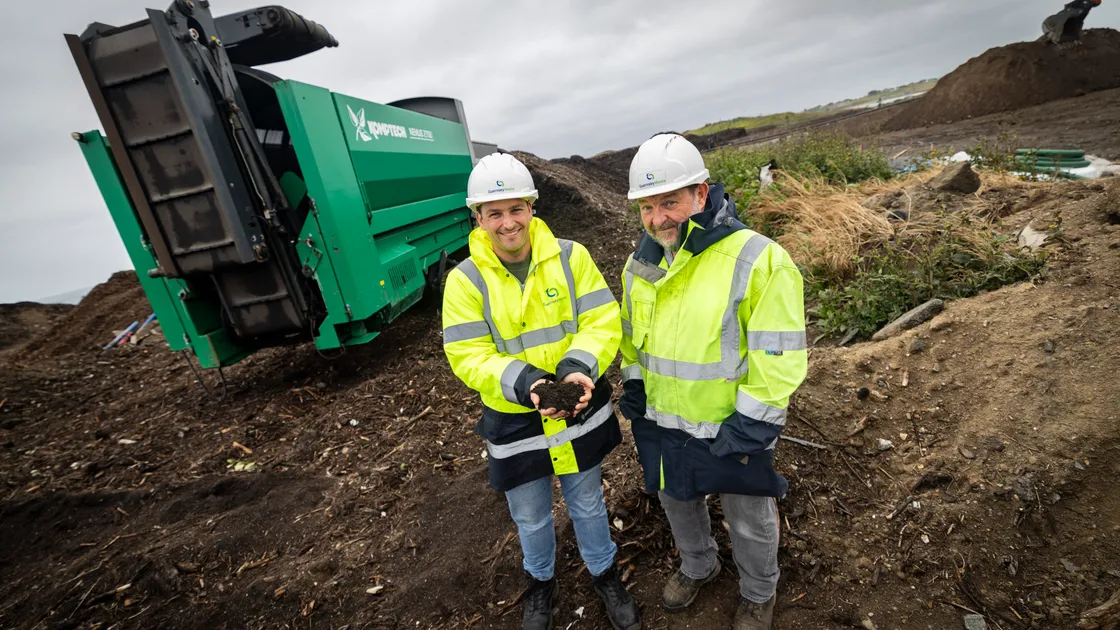
While Guernsey Waste has long been composting green waste at Mont Cuet, a new composting process introduced last autumn means that the compost being produced is far superior in quality, with unwelcome chunks and stones more reliably removed, and a glut of bacteria more reliably cultivated.
‘Our compost is now much higher quality than it used to be,’ said Guernsey Waste waste minimisation and sustainability officer Douglas Button.
‘It also means that there will be less shipping of product onto the island, because we’re generating something ourselves. It’s all made of our green waste – like hedge cuttings, weeds from your garden – and now people can take the compost and put it back into the ground and grow more things, and so it becomes like a self-generating cycle.’
The compost is now being made in windrows – long, narrow heaps of waste that are turned at regular intervals. As the waste material in the heaps decomposes, they naturally reach high temperatures, with Guernsey Waste keeping their windrows at an internal temperature of 70C by regularly turning it to prevent overheating and effectively distribute the oxygen and bacteria in it.
In the next stage of compost manufacturing, it is put through Guernsey Waste’s relatively newly upgraded ‘screening’ machine, which filters out unwelcome parts of the compost such as insufficiently decomposed material and contaminants.
The final product is tested against the UK PAS100 standards, which has revealed it to be biologically active and nutrient rich. It is supposed to provide the greatest benefit to growing and soil health with repeated, long-term use, as it will help improve water retention and soil life.
‘In healthy soil, there’s a lot of different kinds of bacteria and nutrients, and so we want people to use the compost to bring life back into their dead soil,’ said Mr Button.
‘The new compost is actually so rich with bacteria that we recommend that people don’t just plant a seedling in it. We call it soil-improving compost – you’d put maybe 50% compost and 50% soil in your plant pot, so that way it wouldn’t be too much.’
Islanders can collect the new compost for free from Longue Hougue, with larger quantities available from the Longue Hougue land reclamation site by prior arrangement.

You need to be logged in to comment.