

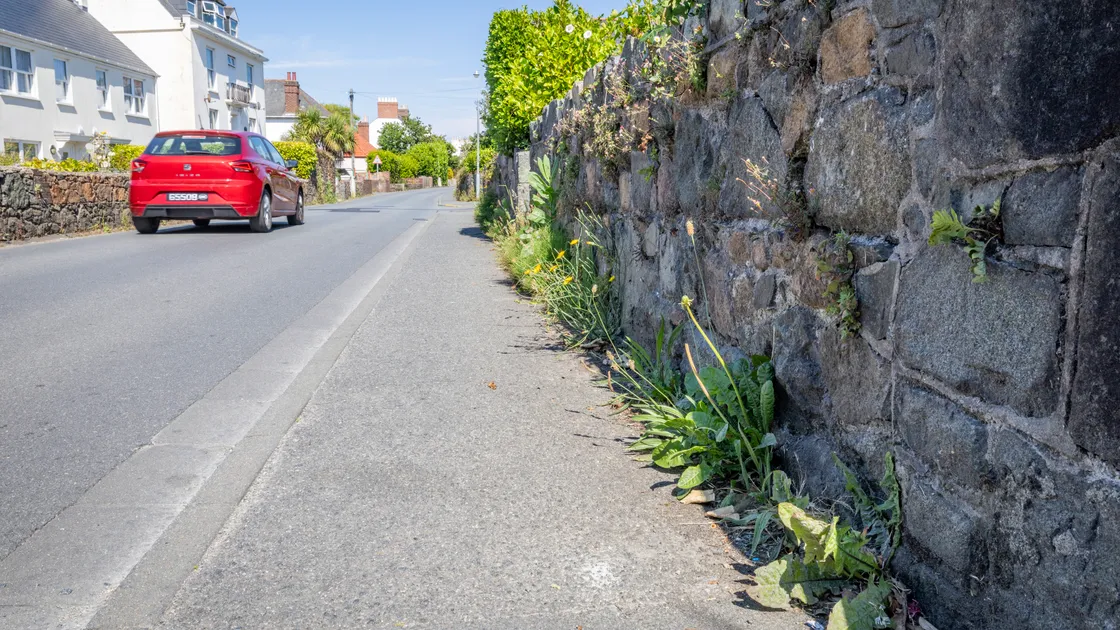
La Societe Guernesiaise has warned that any relaxation on glyphosate-based weedkillers would be a ‘retrograde step’ for the island.
The conservation organisation said it supports methods of weed suppression which cause no harm to the environment, such as the sustainable grazing of the conservation herd and hand-weeding carried out by the Guernsey Conservation volunteers.
‘While there is a legal requirement to control noxious weeds, licensed operators are available to help with this. Only a few plants fall into this category, and many native weeds are an important habitat for insects and pollinators,’ it said.
La Societe said that the ongoing concerns about the roadside growth of what some may call wildflowers and others weeds, was a subjective one, and what some people see as untidiness, others would regard as nature softening the edges of a harsh environment.
‘We are encouraged to manage our gardens in an environmentally-friendly way that ensures space is left for nature, and so it seems counter-intuitive to be so exercised about weed growth.’
It said that in the relatively few locations where safety is an issue, it would request hand-weeding.
But in the past, often after areas were sprayed, the dead material would be left long after it had died, creating a new problem.
‘La Societe is committed to managing its land in an environmentally friendly way. In the past, Guernsey Water has had to cease water extraction from the Vale Pond catchment area because of pollution, not just from glyphosate but in addition, from nitrate run-off,’ said the organisation.
It said it had suffered the same issues at the Colin McCathie Nature Reserve at the Vale Pond, and its other wetland reserves at Le Grand Pre, La Claire Mare, Pre d’Enfer and the Orchid Meadows in the Rue des Vicheries.
La Societe has said it would welcome further debate on how pollution can be prevented in future. But the Vale parish constables believe it is time for the States to reconsider its ban on weedkiller.
This followed meetings with the parishes and Environment & Infrastructure Committee president Adrian Gabriel, where he admitted that the chemicals ban implemented by his committee had not been a success.
‘It was obvious from the start that this was a well-intentioned decision but one doomed to failure unless the States could throw significant resources into keeping the verges weed-free, and they haven’t,’ said Vale senior constable John Niles.
‘We accept that this is a sensitive issue and people have differing views on the environmental aspects of using glyphosate and the need to keep it out of island water courses. But that said, the product has been in use since the mid-1970s and Guernsey has managed any problems with it quite successfully.
‘Our view is that immediately allowing chemical control of roadside verges restores the status quo and would give the States time to reconsider how it could properly introduce manual controls by States Works if, indeed, a weedkiller ban really is necessary.’
Mr Niles said the problem of what has been called ‘scruffy verges’ was not just about appearance and there were safety issues with brambles, nettles and other heavy growth potentially injuring pedestrians and cyclists from uncut verges.
Douzeniers can police hedges but the law does not enable them to issue warning notices for growth coming from the road or the verges.
A new website, weedwatch.gg, has been set up to identify and track areas around the island where weeds have become overgrown.
Users can pin a location on the map, rate it as minor, moderate or severe and leave notes.
The location can be marked as resolved once it has been taken care of, which can be done by anyone who has the time and ability to do so. It appears to be picking up in popularity.


You need to be logged in to comment.