

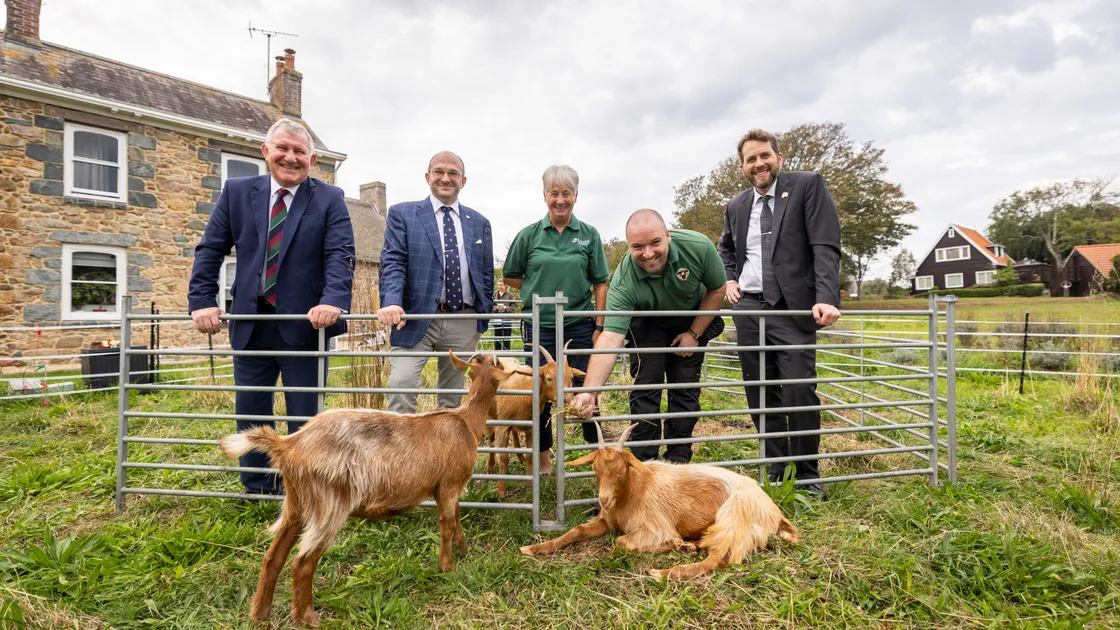
The animals, from different bloodlines, arrived from the UK a couple of weeks ago as part of efforts to secure the future of the breed, following concerns about the limited genetic diversity among Guernsey’s population.
The development comes as three young Royal Goldens are settling into their new role with La Societe Guernesiaise’s conservation herd.
Bramble, Malcolm and Victor Hu-goat joined the herd in August, and are currently based at National Trust’s Les Caches Farm, where they are helping to tackle dense vegetation.
Conservation herd manager Will Harford-Fox said mixed grazing could be more beneficial for wildlife, with goats able to eat vegetation which the Guernsey steers – already used by the herd – tend to avoid.
‘They go into different habitats and basically eat a lot of stuff that the cows won’t eat,’ he said.
‘It’s very useful in using them as a land management tool.’
He said the three goats had already made a noticeable difference at Les Caches and it is hoped a greater variety of vegetation would emerge there next year. The animals were brought from Peter and Mandy Girard’s Golden Guernsey Goat Farm, with the National Trust agreeing to host them initially.
La Societe’s president, Felicity Quevatre-Malcic, extended La Societe's appreciation for the Trust’s hospitality and keen cooperation on this project.
Meanwhile, the separate arrival of 14 goats from the UK is intended to tackle another challenge.
‘There’s a long history of animals being exported and imported, and because numbers are currently so low there are limited genetics,’ said Mr Harford-Fox.
Once released from quarantine, the imported goats will join several island herds. While the conservation herd has not taken one of them directly, Mr Harford-Fox hopes it could eventually use the new bloodlines when Bramble, Malcolm and Victor Hu-goat are old enough for breeding in about two years.
US-based Guernsey Seigneur John Deichler and fellow fief-holder, Brady Brim-DeForest helped fund the establishment of the conservation herd’s goat project, including fencing, animals, handling equipment and shelter. The pair were invited to join the Lt-Governor Sir Richard Cripwell at the farm, to see for themselves the progress the three young goats were making.
Mr Deichler said conservation efforts were also gaining momentum internationally, with work under way to strengthen Golden Guernsey genetics in North America.
‘We were really happy to get these goats here,’ he said.
‘And what’s exciting is this is an international affair to stabilise the breed, which all ties into the awareness of how special this island is. We brought two to North America from Yorkshire, because they were desperate for some Y chromosomal genetics. They had bred their breed into more of an “Americanised” version of Goldens – less true Royal Goldens. So we were able to bring two back to the gene pool, and there’ll be more in time.’
Supporting the breed is particularly meaningful, he said, following the King’s decision to grant it Royal status in 2024.
‘If it matters to him, then it matters to us.’
Mr Harford-Fox said having the support of the island’s fief-holders was very meaningful. ‘It’s the wide-reaching, traditional and local touch of people taking an interest in this.’



You need to be logged in to comment.