
Back in 1975 you could buy a brand new four-door family car for £1,250 or create a greater splash with a sports coupe for a thousand pounds more. You could rent a two-bedroom furnished flat in St Helier for a year for less than £1,000 and eat out at a leading hotel for just £3.50 – with cabaret thrown in.
But you could do all those things with cash to spare if you were the lucky winner of the first Channel Islands Lottery, which has clocked up 50 years this year.
A top prize of £7,500 awaited the lucky winner (who happened to come from Guernsey) when, on Friday 30 May 1975, Deputies Cyril Tanguy and Frank Martel sat alongside each other at Jersey’s historic West Park Pavilion – then called Behan’s West Park – for the historic first draw. Representatives of, respectively, the Jersey and Guernsey Gambling Control Committees, were realising a shared vision for what has turned out to be an enduring collaboration.
Two decades before talk of a National Lottery in the UK, they had both seen the benefits of combining two lotteries which had been operating with some success in each island. Displaying an agility that might impress – if not indeed surprise – many today, politicians in both islands conducted discussions and steered propositions through their respective States Assemblies to create a cooperative venture which has not looked back since.
Nonetheless, the columns of the Jersey Evening Post reveal something of the sensitivity felt during the discussions. When news of the talks first broke in Guernsey, Senator Clarence Farley – then president of Jersey’s Gambling Control Committee – was distinctly cautions, quick to deny any official plans.
‘Deputy Reuben Dorey and I had a general chat about our lotteries but we did not get very far,’ Senator Farley said in July 1972. ‘There has been nothing approaching an agreement. My committee would be prepared to discuss a merger if Guernsey raises the matter officially but we are happy as we are.'
Things were rather different behind the scenes, however. Prophetically, when the Guernsey States established its lottery in 1971, four years after Jersey’s, a special lottery investigation committee was already gazing into its crystal ball as it wrote: ‘We are of the opinion that time will show that both islands have something to gain from a joint lottery… we suggest that the Lottery Committee… should bear in mind the possibility of a Channel Islands Lottery being established.’
The economics of the two lotteries was ultimately to provide the impetus. Jersey’s lottery had begun in 1967 but the arrival of Guernsey’s immediately hit sales across the water. The larger island’s 12 draws in 1967 generated a net profit of £169,203, a figure exceeded over the three years that followed. But there was an immediate downturn when rival lotteries co-existed, as a report subsequently presented to the States of Jersey conceded:
‘A comparison of the number of tickets sold month by month in 1971 with the corresponding months in 1970 shows that the advent of the Guernsey Lottery had a marked effect on the sales of Jersey Lottery tickets,’ it said.
In fact, it was an innovative Guernsey ‘snowball’ prize that had proved attractive not just to Sarnians but also to buyers across the water. To arrest that decline, Jersey introduced its own jackpot prize – sales of Jersey tickets to Guernsey residents began to outstrip the Guernsey tickets bought by their counterparts in Jersey.
Strictly speaking, legislation in each island made this market illegal. Lottery tickets could not – in theory at least – be sent to participants living elsewhere. Purchase was only allowed in the island where the draw was taking place and tickets could not then be posted elsewhere. But there was a self-evident financial disincentive for both islands to do anything about it.
It did not take long for both Gambling Committees to draw the obvious conclusion – competition, far from being beneficial, was simply underlining the potential advantages of a single pan-island lottery for a public clearly eager for a flutter.
Guernsey, it was agreed, had more to gain. As the report of the president of the Guernsey Committee stated: ‘In the committee’s opinion, greater profits will accrue to Guernsey by way of a joint lottery in the light of: the reduced operating costs that would be incurred; the increased number of tickets that could be sold as a result of the more attractive prizes that could be offered; [and] the increased number of tickets that could be sold in Guernsey as a result of the absence of competition from Jersey.’
Discussions between the two committees were described as ‘cordial’, as the minutes of the Jersey Committee testify. Amusingly, in our age of instant online communication, one of the most practical challenges to grapple with 50 years ago was simply how to get the results of a draw accurately relayed from one island to the other. Local radio stations had yet to be established and a television link was ruled out on cost grounds; instead, results would be sent by telex, with a copy immediately telexed back – just to confirm the communication had been accurately received.
At first, though, it took time for islanders to acclimatise to this new arrangement. Initial sales were not what was expected with B J O’Connor, main agent in Jersey, attributing this to ‘the traditional independent nature of Jersey and Guernsey people’. Soon, however, it caught on. Draws became eagerly-awaited affairs, aided by Fred, a machine that might have been borrowed from Doctor Who’s Tardis, generating results from numbered balls in transparent chambers. Short for 'Fantastically Reliable Electronic Device, Fred became the advertising emblem of the lottery until his replacement by a computer called Super Fred.
So much had he become part of island life that you could sense more than a trace of sadness in Senator Clarence Farley’s announcement that Fred was to be ‘put into retirement’. He hoped he might be of interest to the Jersey Museum.
But if his successor Super Fred – effectively a screen, connected to a printer, on which randomly generated numbers appeared – was rather less prepossessing, its Thursday afternoon draws were to be no less eagerly awaited. They were events.
Printing of the Jersey Evening Post – then reaching the streets around 3.30pm – was delayed on lottery days to accommodate an up-to-date ‘news in brief’ of that day’s winning tickets, with a journalist sent up to the fort in person to join representatives of the other media to check and phone-in the details.
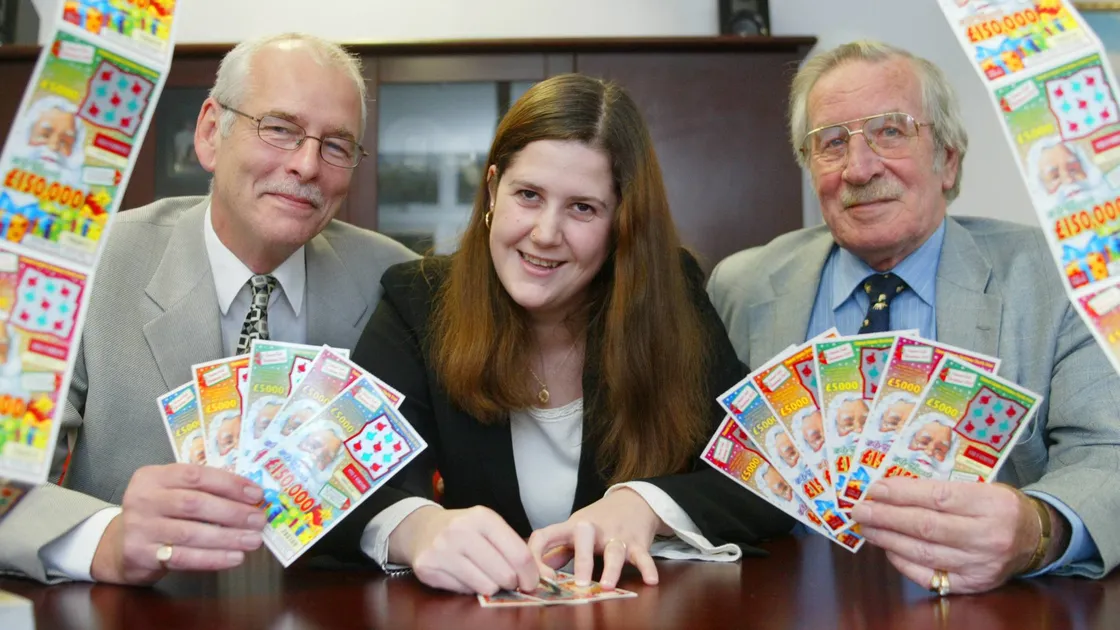
Over the years proceeds have fluctuated with ticket sales. During the 1980s the bumper Christmas Draw was introduced, followed in 2004 by the instant-win scratch card, but Jon Taylor, Guernsey States’ head of lottery business, is in no doubt of the most significant development – the appointment in 2011 of Scientific Games International.
He explained: ‘Revenues went from between £2-3m. towards seven in a year. Scratch card games were then very popular in the UK and this was also a global trend as lotteries evolved to become part draw-based, National Lottery style. and part instant scratch card format.’
Today a strategic review meeting takes place every three months, attended by officers from both islands, their lottery distributors and representatives from SGI. Following an annual game plan, the group discusses the detail of the games to be launched and the logistics of ticket printing and delivery with the verification files that contain the results.
Those who fondly recall the excitement of those regular lottery draws, conducted for the most part in Jersey, a recent downturn in Christmas lottery sales – which combine a draw with instant scratch card prizes – may come as a disappointment. The frequency of scratch card wins had been generating additional sales as participants reinvested winnings in more Christmas tickets.
But that has changed in recent years as Mr Taylor explained.
‘Although participant numbers are strong, the individual is spending a lot less than in previous years. Research indicates that this is due to three factors: the increased cost-of-living, the popularity of other lottery games and diminishing first prize amount.’
Perhaps in Jersey at least that may change this year. What Mr Taylor described as the ‘friendly competitive nature' of the traditional Christmas draw had come under strain recently as Guernsey, defying the laws of probability, scooped the first prize six years on the trot. But last year, the £483,795 jackpot winning ticket was bought in Jersey.
‘It will be interesting to see whether sales in Jersey go up this year as a result,’ he smiled.








You need to be logged in to comment.