
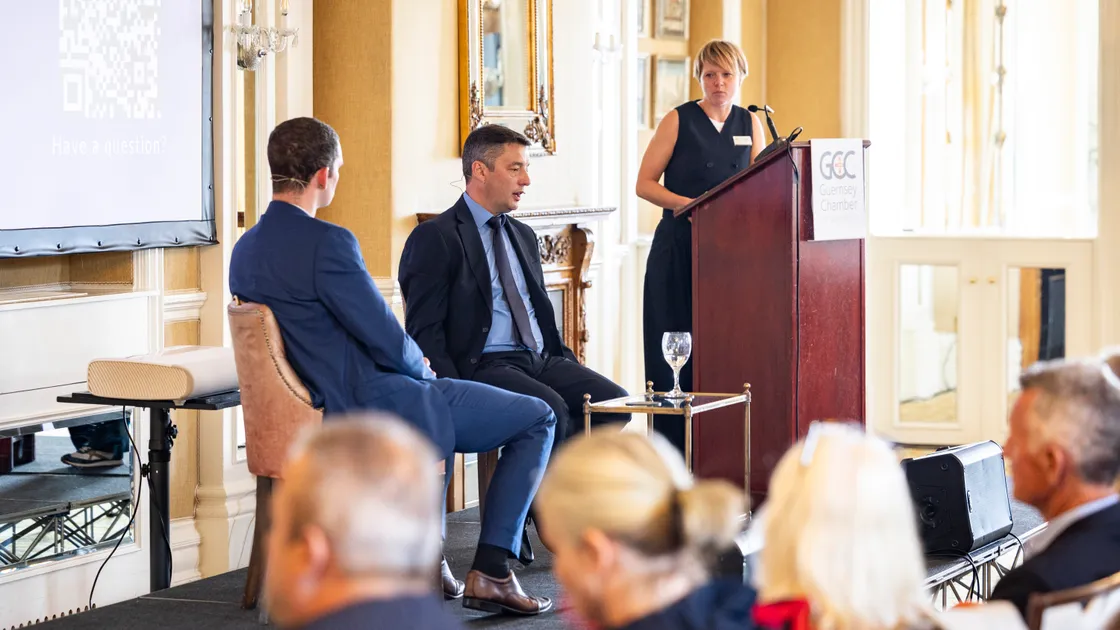
Boley Smillie said he did understand why the States sometimes bit off more than it could chew.
‘Those working in the public sector do so because they want to make the island better, and they are working for elected deputies who want to make the island better, so it is natural that they always want to do more, but we have to be realistic over what we can achieve,’ he said.
Mr Smillie was first interrogated by the event moderator, John Fenandez, and then answered questions from Chamber members.
He revealed that the MyGov project remained completely paused while the States redefines what it wants to achieve.
‘When I asked people to tell me exactly what MyGov was, no one really could. Of course, it is right to move services online but we have to do so in a way that can be properly managed.’
The States CEO was very candid over the current state of IT provision within the island’s public service.
‘We have a huge technology deficit within the organisation. I am seeing a big improvement but we are still miles from where we need to be. But the view of some people of the public service being stuck in its ways and not wanting to embrace tech is unfair.’
He said most civil servants are keen to adopt modern ways of working and the States was starting to embrace AI, but accepted so far this was just scratching the surface. He also warned that people shouldn’t expect to see a reduction in States spending on IT projects.
‘We are right to spend many millions of pounds on IT transformation, that has not been the problem, the problem has been not seeing the benefits from it.’
Mr Smillie, who has been in the top job for just over year, was quite bullish over fixing the problems with the Revenue Service, despite a show of hands in the room revealing that about two thirds were waiting for something from the department.
‘The problems historically far exceeded what the public probably knew about, but we are starting to make real progress. Now we have a clear leadership function and a very capable leader. I’ve seen amazing progress in the last six months, but I recognise that there will be lots of people in the community who will not have seen that yet.’
Asked about Guernsey working more closely with Jersey, Mr Smillie said quite a lot of that is already going on and that inter-insular relationships should not be judged solely on ferries.
‘It’s a myth that co-working doesn’t go on, it does, perhaps one thing we should learn from Jersey is to shout more about our successes. I would like to see even more joint working though, perhaps on things like health procurement.’
The States CEO said one of the biggest strengths of the public sector was those actually delivering services. He described the front line as one of the best you will find anywhere in the world, and said one of the keys to progress was to listen to them.
‘More people are now speaking up with ideas on how to improve than they were a year ago but we need to make the front-line more empowered and more engaged because they’re the ones with the real knowledge.’
Mr Smillie accepted that morale remained an issue and that the performance of the civil service still needed to improve. His formula for achieving that was quite straightforward.
‘We need to do what we promise more often. That will involve more prioritisation, and much greater transparency. Sunlight is often the solution.’
He used the event to announce that a new chief officer of the Health & Social Care department would be appointed within two weeks, with other departmental chief officers to follow. He said this reflected the shape of the public sector in Guernsey.
‘We are not one organisation, we are a series of organisations, and if each one has a clear leader it will improve responsibility and accountability, but there will be no place for silo working.’
The top civil servant said good progress was being made in meeting an initial savings target of £4m., with much of that being achieved by reducing the number of external contracts. He said there was often good reason to bring in outside expertise but that it had been happening too often.
Asked if he was enjoying his job as Guernsey’s top civil servant, Mr Smillie was unequivocal.
‘I love the job. Lots of things go well, but there is always something going wrong, and that makes the role much more interesting.’





You need to be logged in to comment.