
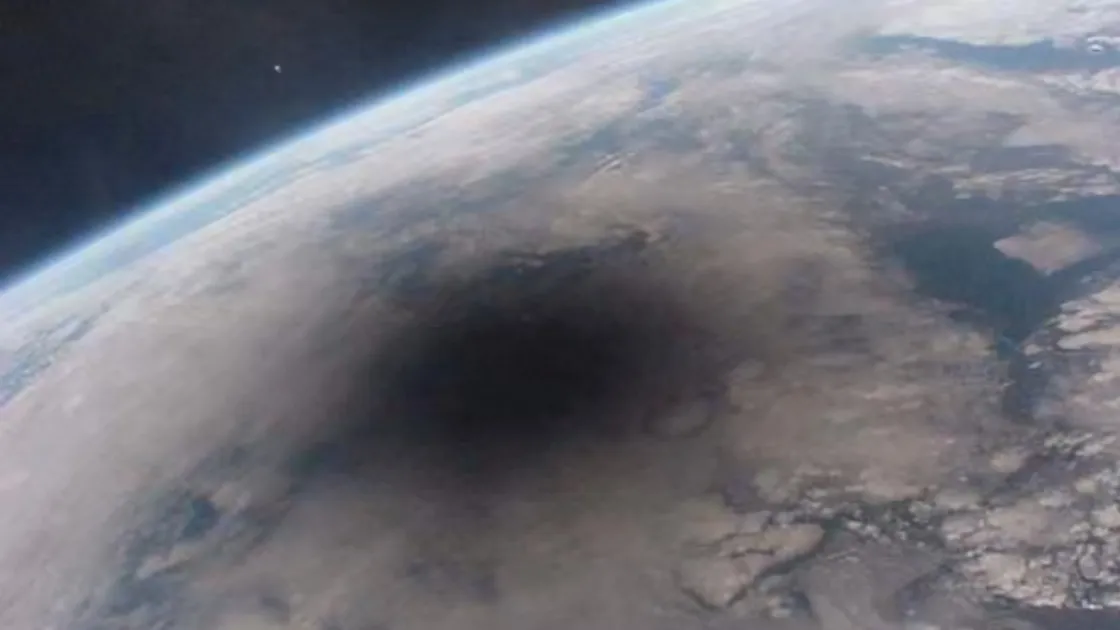
Many readers will recall the great eclipse of 1999. In the UK and Alderney, a total eclipse was witnessed, while in Guernsey the Moon obscured the Sun by 99.9%. It was a momentous event enjoyed by thousands of islanders and tourists. The next total solar eclipse in Guernsey will not be until 2081.
However, over the next three years there will be some significant partial eclipses, the best of which will be this year on 12 August, when the Moon will obscure the Sun by 94.4%. We can expect the light to dim, temperatures to drop and nature to respond for a few minutes. The eclipse will start at 6.21pm as the Sun is setting in the west, reaching a maximum at 7.17pm when the Sun will be about 11 degrees above the horizon. The eclipse will finish at 8.10pm, as the Sun continues to set.
Although at its peak when the Sun will be 94% obscured, it will still be extremely dangerous to look at it directly with your naked eye. Doing so can cause permanent loss of vision.
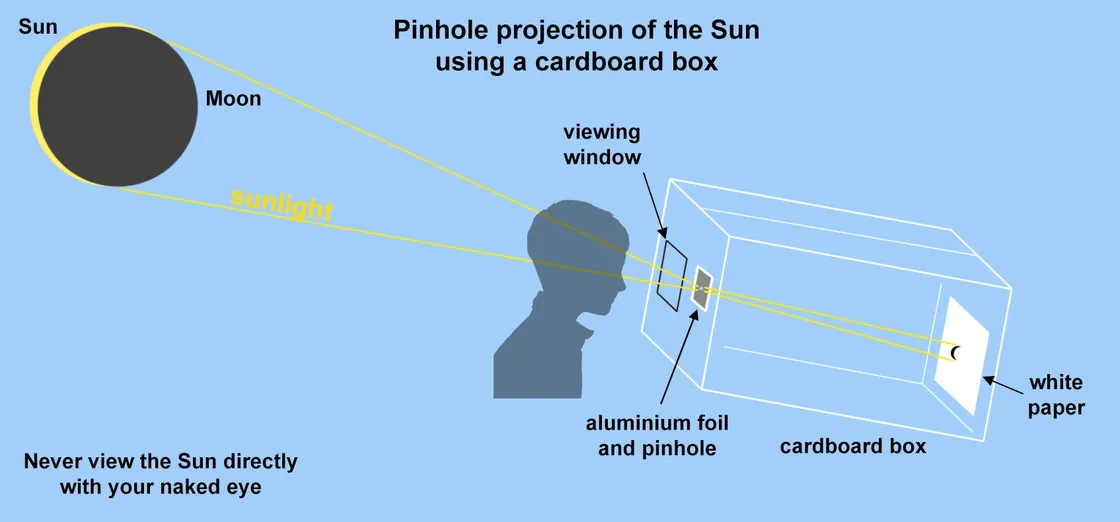
There are several safe ways to view the Sun. One is utilising pinhole projection, with your back to the Sun. The simplest method is to use two sheets of white paper or card. A slightly more complex method is to make a pinhole box projector.
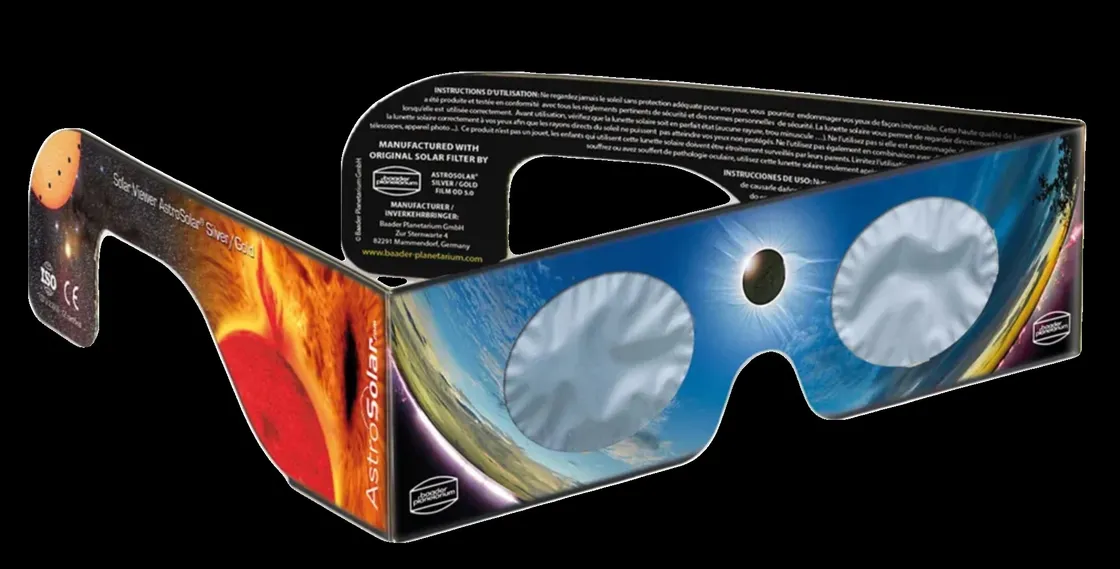
Another way to view a solar eclipse is with solar eclipse glasses, which are designed to reduce the sunlight intensity by 99.999%. In addition, they also provide 100% ultraviolet and infrared protection. Solar eclipse glasses should be CE/ISO certified and conform to EN ISO 12312-2:2015. They make a great purchase as you can settle down in a comfy chair or seat and pop them on to enjoy the whole event safely.
'It is particularly important that children are supervised at all times, as they do not always appreciate the danger and can get excited about such events'
It must be emphasised that solar eclipse glasses must NEVER be used in conjunction with any other optical instruments such as binoculars, spotting scopes or telescopes.
To view a solar eclipse through optical instruments such as these, it is essential to use filters specifically designed for the purpose. Solar eclipse glasses and other specialist filters can be obtained from reputable dealers such as Rother Valley Optics or First Light Optics in the UK. Please read and follow all the safety instructions that are provided by manufacturers.
It is particularly important that children are supervised at all times, as they do not always appreciate the danger and can get excited about such events.
What is a solar eclipse?
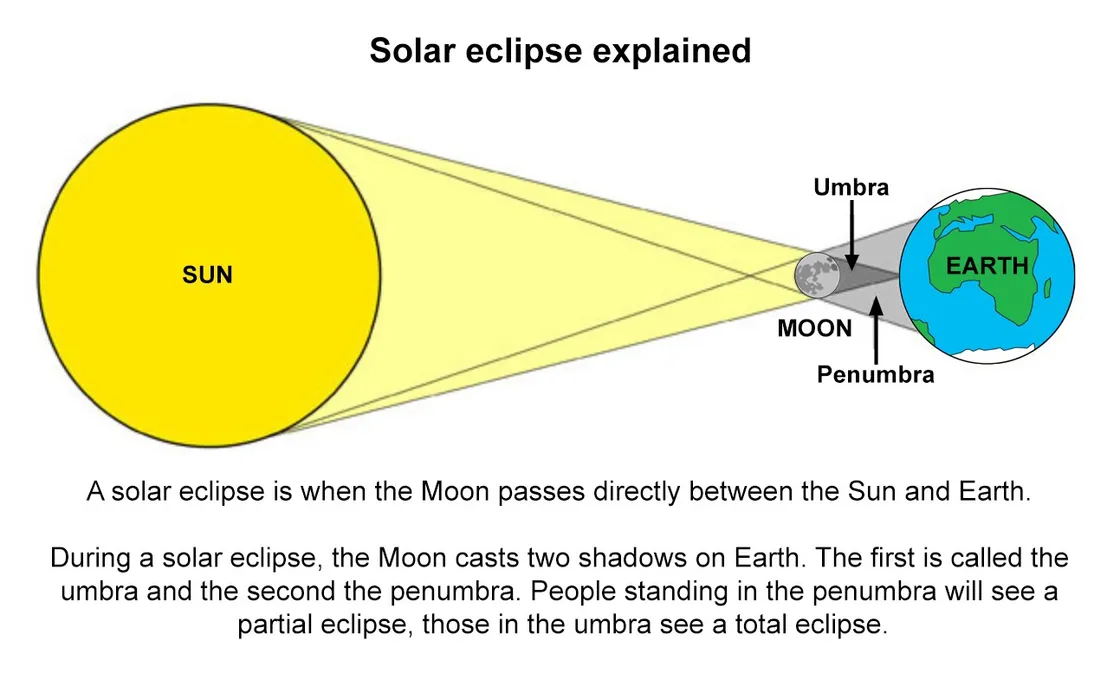
A solar eclipse happens when the Moon passes exactly between the Sun and Earth, blocking out the daylight for a short period of time. But the Sun and Moon are completely different sizes, so how can the Moon block out the Sun, which is much larger? It is about ratios: the Sun is 400 times the size of the Moon, but it is also 400 times as far away. Thus, from our viewpoint on the surface of Earth, the apparent size of both celestial objects is the same. As the Moon blocks the Sun’s light, it casts a shadow on part of the Earth. The shadow creates a trail as the Earth rotates which is called the path of totality. Anyone observing from within the central region of the shadow (umbra) experiences a total eclipse, while those in the outer part of the shadow region (penumbra) experience a partial solar eclipse.
Interesting fact – the Moon is moving away from Earth at a rate of 3.8cm per year, so in about 500 million years it will no longer be possible to see a total solar eclipse from Earth!
Cardboard box pinhole projector
You will need:
Empty cardboard box
Sheet of white paper or card
Aluminium foil
Tape
Pin, scissors
Project steps:
Open the box, using tape, cover one of the inner sides with the white paper.
On the opposite side to the white paper, cut two side by side, square holes in the box which are at least 10cm apart (one smaller for the aluminium/pinhole to focus the sunlight, and the other slightly larger to view through).
Tape a piece of aluminium foil over the smaller hole.
Take your pin and neatly make a small hole in the aluminium foil.
Seal the box, so it is dark inside.
Your solar eclipse viewer is now ready to use. You can go outside and test it. Stand with your back towards the Sun, tilt the box up with the pinhole facing the Sun and look through the viewing window. You might have to adjust your position slightly to find the image of the Sun.
Get creative – when you have finished your pinhole projector you can decorate the outside of your box.
A simple pinhole projector with two sheets of card
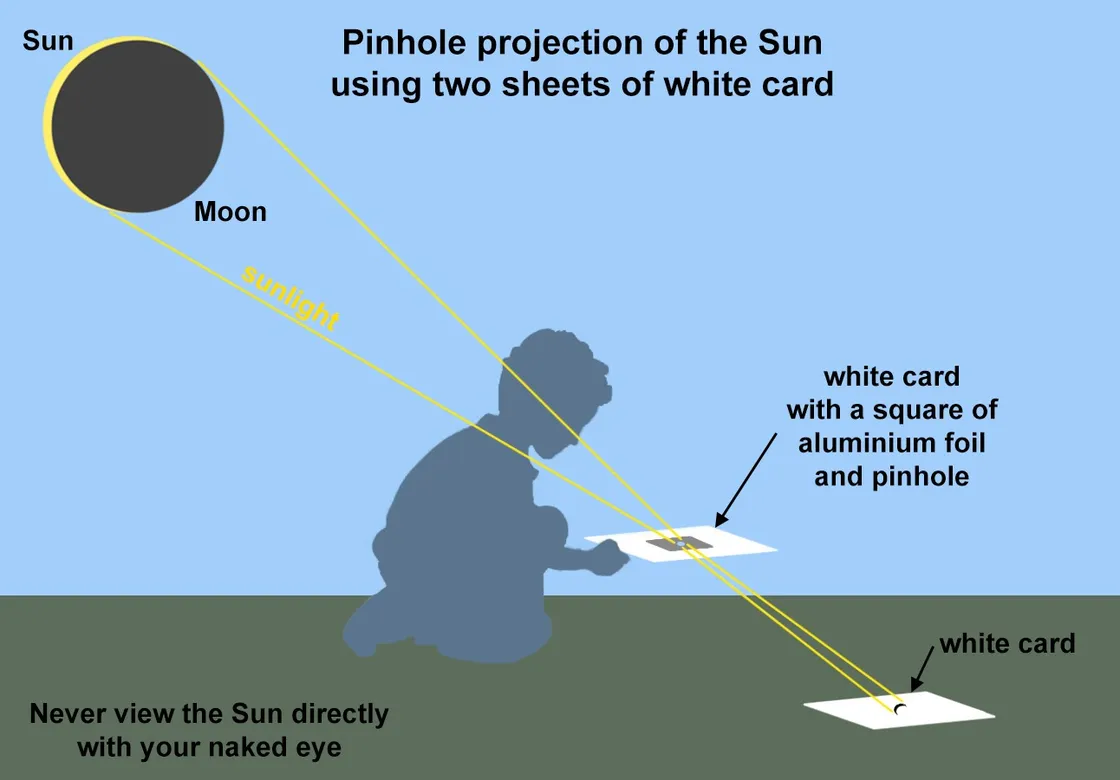
You will need:
Two sheets of white card
Aluminium foil
Tape
Pin, scissors
Project steps:
Cut a 4 to 5cm square or rectangular hole in the middle of one piece of card.
Tape a piece of aluminium foil over the cut out.
Using a pin, make a small neat hole in the centre.
Try it out. Place your second piece of card on the ground. With your back towards the Sun, hold the card with the foil/pinhole above the ground so you can view the projected image on the card.
To make a slightly better image, try putting the card on the ground in an area which is shaded, while you hold the other piece of card in the sunlight. You can also tilt both pieces of card towards the Sun.
For extra fun, try making several pinholes and try different sized holes to see the effect. Perfectly round holes with a nice clean edge will give the best projection.
Note: to simplify this project, you can omit the foil and simply make a pinhole directly into the white card.
Look under tree canopies
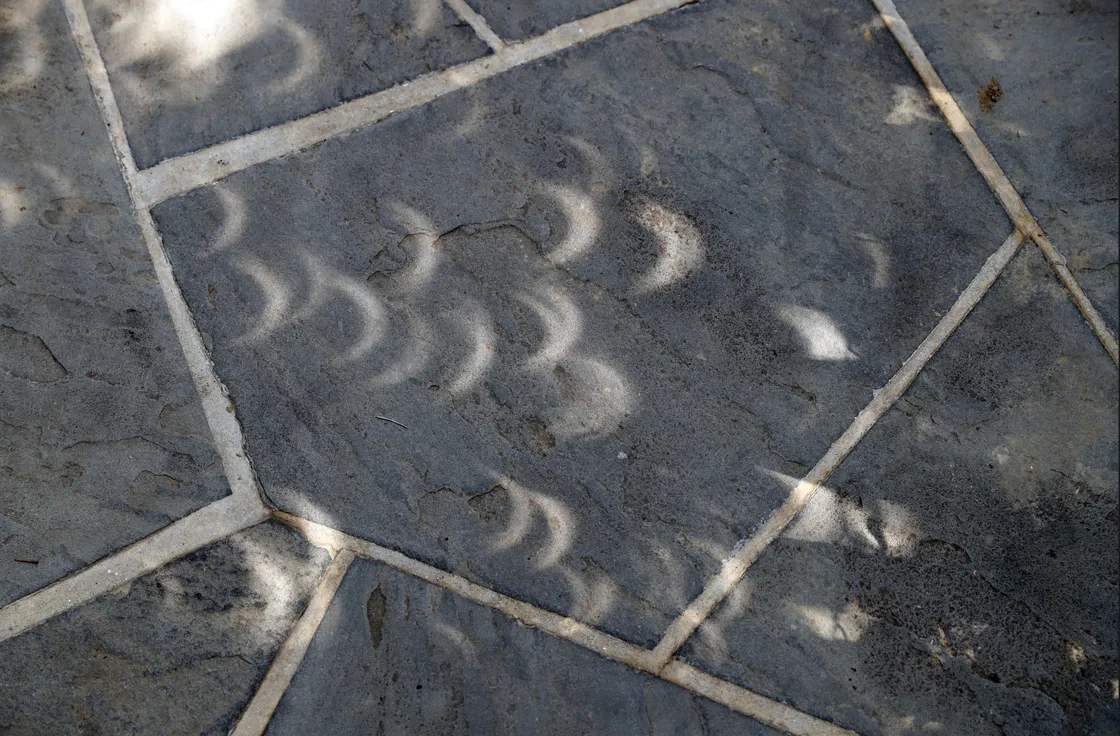
During a solar eclipse, tree canopies act as multiple pinhole projectors. The sunlight passing through small gaps between leaves will project many images of the crescent Sun.
Using a kitchen colander to view a solar eclipse
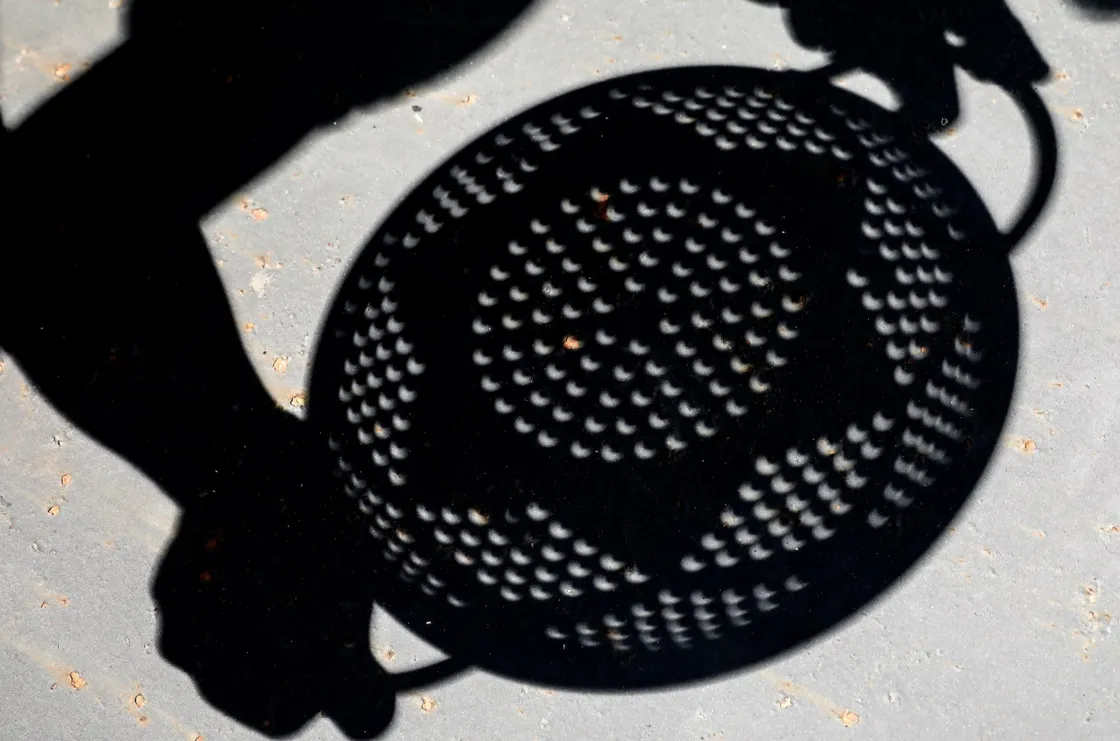
You can use a standard kitchen colander to view a solar eclipse. With your back to the Sun, hold the colander above the ground so it creates a shadow. Move the colander up and down to find a compromise between the image size and sharpness. The higher above the ground it is, the larger the image will be, but the higher it is, the less sharp the image will be. You can go outside and practice at any time before the eclipse. Thin metal colanders work best.






You need to be logged in to comment.